
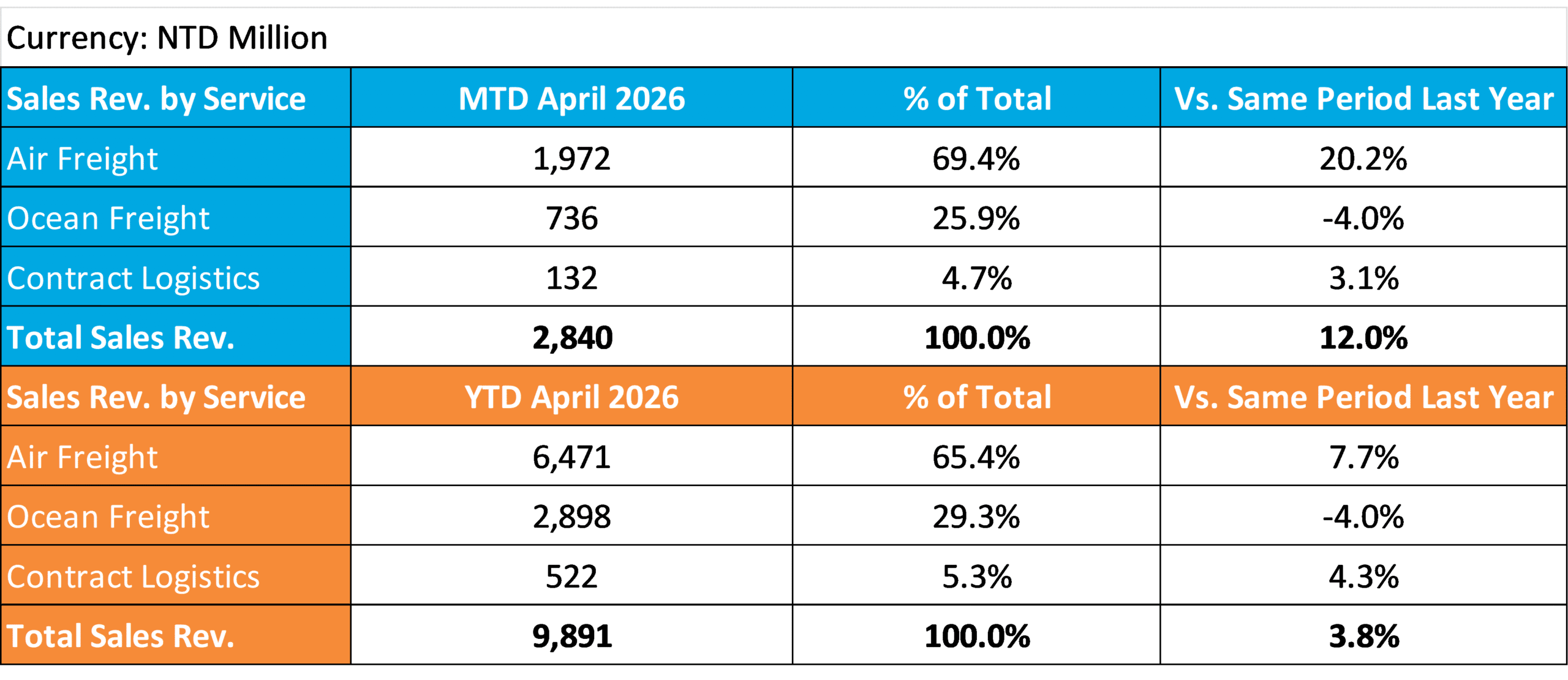
Dimerco Express Group (5609) today announced consolidated sales revenue for April 2026, reaching NT$2,840 million, a 12% increase compared to the same period last year. Driven by customer shipment demand, air freight volume increased by nearly 20% year-over-year, while ocean freight volume decreased slightly compared to the same period last year. Overall shipment volume remained on a steady growth track. For the first four months of 2026, the Group’s air freight volume grew by approximately 20% year-over-year, while ocean freight volume increased by nearly 10%. Consolidated revenue reached NT$9,891 million, up 3.8% year-over-year, demonstrating continued operational resilience amid freight rate pressure and market volatility.
Rising geopolitical tensions in the Middle East have heightened security risks across the Persian Gulf and surrounding airspace and maritime routes. Restrictions on transit through the Strait of Hormuz and the potential risk of blockade have led to changes in regional capacity deployment, with effects beginning to spill over to major Asian transshipment hubs and driving increased congestion at certain ports. Countries including India, Sri Lanka, Singapore, Malaysia, Indonesia, and the Philippines have all been affected to varying degrees, further impacting regional transportation efficiency and adding uncertainty to the global logistics system.
As energy prices rise and aviation fuel costs climb, airlines have gradually adjusted fuel surcharges and flight allocations, driving up overall logistics costs. Against this backdrop, the market has also seen a trend toward transportation mode reallocation, with some cargo volumes shifting to diversified solutions such as ocean freight, rail, or sea-air services in order to balance cost and transit time. As a result, supply chain decision-making continues to become more complex.
In addition, U.S. Customs and Border Protection (CBP) announced the launch of Phase One of CAPE, the Consolidated Administration and Processing of Entries. Starting April 20, 2026, companies can electronically apply for IEEPA tariff refunds through the ACE Portal. This marks a shift in the refund process from passive waiting to active filing by companies or customs brokers. However, the current scope of CAPE Phase One does not yet fully align with the scope indicated by the U.S. Court of International Trade (CIT) ruling. For cases that are not yet eligible at this stage, importers should continue taking existing refund response measures.
In response to these policy changes, Dimerco recommends that shippers immediately begin reviewing and categorizing import entries affected by IEEPA, confirm that ACE Portal access and ACH refund setup have been completed, and review filing authorizations between the importer of record (IOR) and customs broker. Companies should also prepare CAPE declaration documents in the correct format to ensure that filing information is complete and compliant.
In this environment, Dimerco continues to strengthen its trade compliance and supply chain solutions capabilities to help customers navigate challenges arising from tariff policy changes and market volatility. By combining trade compliance analysis with supply chain design expertise, Dimerco provides integrated professional services to help customers assess product classification, tariff applicability, and supply chain configurations, reducing tariff costs and managing operational risks in a shifting policy and market environment.
Meanwhile, Dimerco leverages its global operating network and digital systems to help customers gain real-time visibility into capacity changes and cost fluctuations, while providing diversified and flexible transportation solutions across air freight, ocean freight, rail, and sea-air services. This enhances supply chain agility and responsiveness. In addition to existing China-Europe rail services, emerging routes such as sea-air solutions via the U.S. West Coast have also begun to appear in the market. However, these remain largely case-by-case applications and have not yet become mainstream transportation modes. This primarily reflects the growing trend among companies seeking flexible solutions amid high costs and longer transit times.
In the air freight market, AI-related cargo continues to drive U.S. import demand. At the same time, under the impact of the Middle East situation, some passenger flights have been reduced, tightening belly cargo capacity, particularly on Asia-Europe routes. With fuel surcharges continuing to rise, overall logistics costs are trending upward. Kathy Liu, VP of Global Sales and Marketing at Dimerco, said that while traditional cargo demand remains relatively stable, overall cost pressure is gradually increasing. As capacity tightens and surcharges rise, companies need to plan shipments earlier and manage logistics costs more carefully.
In ocean freight, tensions in the Persian Gulf remain elevated, prompting some companies to arrange shipments earlier in order to avoid fuel surcharges and pre-holiday shipping pressure. Congestion at major Asian transshipment hubs has intensified, further adding pressure to market capacity. Under the impact of fuel cost volatility, carriers continue to adjust spot freight rates, with more noticeable increases on routes with stronger demand. However, on routes where demand is relatively weak, the market is seeing both rate increases and declining demand at the same time. Ted Chen, Global Sales and Marketing Director at Dimerco Ocean Freight, noted that fuel costs at major bunkering hubs continue to rise. If conditions do not improve, the market may face a risk of supply shortages in the future, further affecting carriers’ subsequent adjustments to freight rates and service networks.
In an environment of heightened uncertainty, supply chain management is shifting from a reactive approach toward more forward-looking strategic planning. By combining its global operating network, trade compliance expertise, and digital capabilities, Dimerco helps customers balance capacity, costs, and geopolitical changes, improving supply chain predictability and responsiveness.
Spokesperson: Jack Ruan +886 921-062500 / +8862 2796-3660#222
Find out more on Financial Overview