
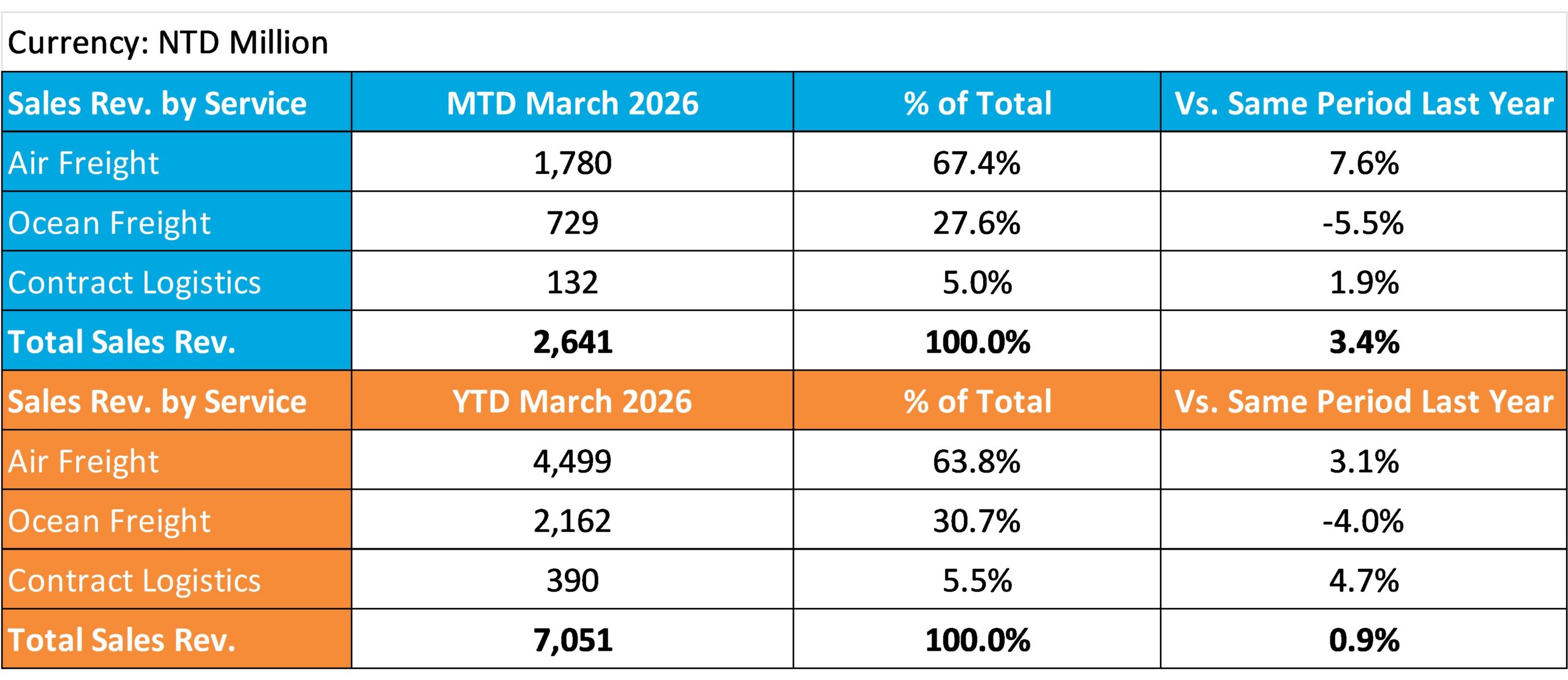
Dimerco Express Group (5609) today announced the consolidated sales revenue for March 2026, reaching NT$2,641 million, a 3.4% increase compared to the same period last year; a 28.4% increase compared to the same period last month. Driven by customer shipment demand, air freight volume increased by nearly 20% year-over-year and surged about 40% month-over-month. Ocean freight volume remained largely in line with the same period last year, with a month-over-month increase of approximately 10%, supporting overall steady growth in total shipment volume. However, revenue performance was slightly impacted by lower market freight rates compared to the same period last year. For the first quarter of 2026, the Group’s air freight volume grew by approximately 20% year-over-year, while ocean freight volume increased by nearly 10%. Consolidated revenue reached NTD 7,051 million, up 0.9% year-over-year, demonstrating solid operational resilience.
Rising geopolitical tensions in the Middle East have heightened security risks across the Persian Gulf and surrounding airspace and maritime routes, adding uncertainty to the global logistics system. According to market observations and industry data, restrictions on transit through the Strait of Hormuz and the potential risk of blockade have begun to intensify congestion at major Asian maritime hub ports. Countries including India, Sri Lanka, Singapore, Malaysia, Indonesia, and the Philippines have all been affected to varying degrees.
As energy prices rise and aviation fuel costs increase, airlines have gradually adjusted fuel surcharges and flight allocations, driving up overall logistics costs. The market is also closely watching the potential shift of some cargo volumes to ocean freight or sea-air solutions. As a result, risks related to transit time and cost fluctuations are increasing. This trend also reflects the ongoing restructuring of supply chains, with growing demand for diversified transportation modes.
In addition, the latest Section 232 tariff executive order announced by the United States officially took effect on April 6, introducing significant changes to the way duties are applied to steel, aluminum, and copper-related products. The new approach bases tariffs on the total declared customs value of the goods, substantially increasing the effective duty burden for certain products. At the same time, the new framework introduces differentiated Annex classifications and transitional tariff rate structures, making the conditions for tariff application more complex.
In light of this policy change, Dimerco recommends that shippers promptly review the tariff applicability of their products and reassess their supply chain configurations. As duties are now calculated based on the total product value, companies need to re-evaluate product classification, country of origin, and metal content structure, and determine whether different tariff categories or relevant exemption provisions may apply. In particular, for composite materials or high-value-added products, the tariff cost structure may change significantly.
At the same time, companies should also pay attention to optimization opportunities under the new regime, including whether their products meet metal content thresholds, qualify for lower tariff classifications, or are eligible for manufacturing drawback programs. As tariff application logic becomes increasingly complex, the market is shifting from a purely compliance-driven approach toward a more strategic approach to tariff and supply chain management. In response to this environment, Dimerco continues to strengthen its trade compliance and supply chain solutions capabilities to help customers navigate challenges arising from tariff changes and market volatility. By combining a professional team with expertise in trade compliance analysis and supply chain design, Dimerco supports customers in reviewing product classifications, assessing tariff applicability, and optimizing supply chain configurations, thereby reducing potential tariff costs and operational risks.
Meanwhile, Dimerco leverages its global operating network and digital systems to help customers gain real-time visibility into capacity changes and cost fluctuations, while providing diversified transportation solutions, including flexible combinations of air freight, ocean freight, and sea-air services. This enhances supply chain agility and responsiveness to change.
In the air freight market, the Middle East situation has driven up fuel costs, prompting airlines to continuously adjust fuel surcharges and flight allocations, thereby increasing overall logistics costs. As capacity tightens, air freight rates are also gradually gaining support. Kathy Liu, Vice President of Global Sales and Marketing at Dimerco, noted that amid tightening capacity and rising costs, the market has observed airlines and some logistics service providers progressively adjusting surcharge structures, with air freight rates showing upward momentum.
In ocean freight, the situation in the Persian Gulf has had a tangible impact on the market, including shipment delays, rising fuel surcharges, and worsening port congestion, all of which are placing pressure on overall route stability. Cargo arrangements to the Middle East have also become more cautious, with certain special cargo types, including temperature-controlled goods and dangerous goods, facing stricter operational requirements and approval standards. Ted Chen, Global Sales and Marketing Director at Dimerco Ocean Freight, pointed out that rising fuel costs are gradually being passed through the broader supply chain and reflected in various surcharges across the market. Beyond ocean freight, this trend is also affecting rail and road transportation, further driving up overall logistics costs.
In an environment of heightened uncertainty, supply chain management is shifting from a reactive approach to a more forward-looking strategic adjustment. Leveraging its extensive operating network across Asia and globally, real-time insight into trade compliance and market changes, as well as integrated multimodal and digital capabilities, Dimerco continues to help customers maintain supply chain stability in a volatile environment while enhancing overall operational efficiency and resilience.
Spokesperson: Jack Ruan +886 921-062500 / +8862 2796-3660#222
Find out more on Financial Overview