
When discussing regional logistics hubs in Asia, Singapore and Hong Kong dominate the conversation. Vietnam, Thailand, and Indonesia attract most of the China Plus One attention. The Philippines rarely makes the shortlist, and that is a strategic blind spot many shippers are only beginning to recognize.
Shipping from the Philippines offers real advantages for companies managing electronics exports, regional distribution, and international freight.
The country has a well-established manufacturing base, a strong network of economic zones, direct access to major Asia-Pacific trade routes, and port infrastructure across Manila, Cebu, and Subic Bay.
For the right supply chain configuration, it is not simply just an alternative to more prominent hubs.
Why the Philippines Matters in Global Supply Chains
The Philippines has long been a significant player in global electronics manufacturing. Electronics products ranked as the country’s top export category in 2025, accounting for the majority of total merchandise exports.
Semiconductors, circuit boards, and electronic components produced in PEZA-accredited zones in Laguna, Cavite, and Clark feed directly into the supply chains of major multinationals across Asia and North America.
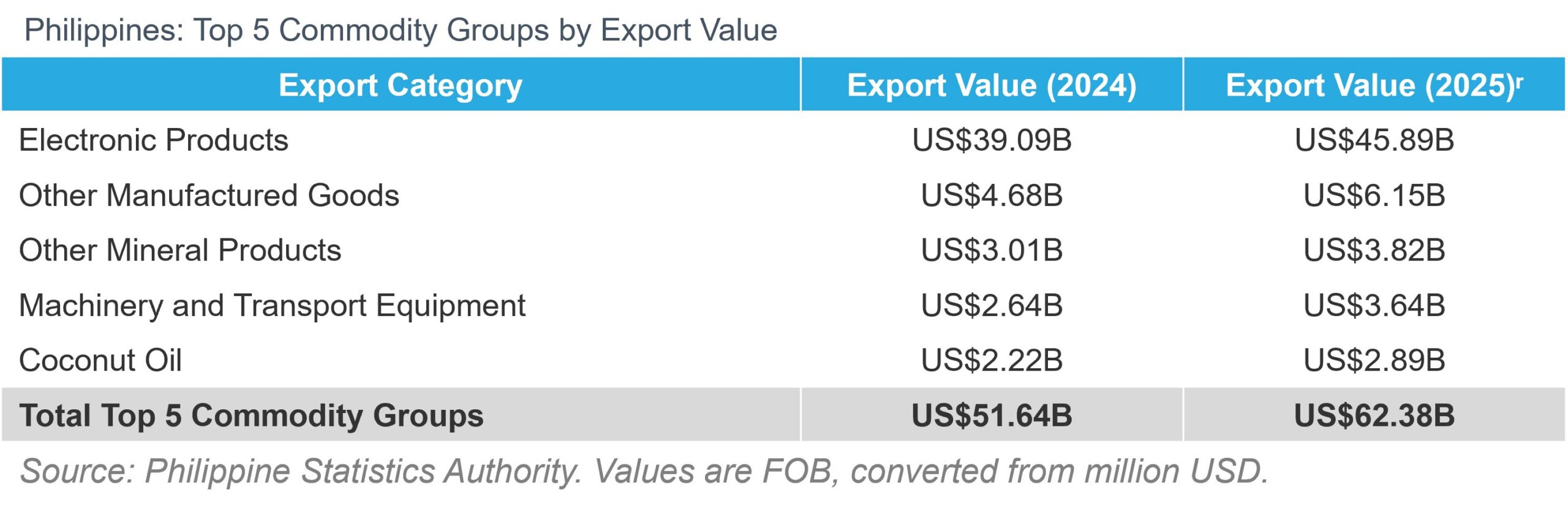
As companies continue diversifying manufacturing operations across Southeast Asia, the Philippines is increasingly relevant as both a production base and an export origin.
Its strong trade relationships with the United States, Japan, China, Singapore, and other ASEAN economies give it broad connectivity that supports a wide range of Philippines logistics strategies, from point-to-point exports to integrated regional supply chain roles.
Strategic Location Within Southeast Asia
The Philippines sits along major Asia-Pacific trade routes, positioned between Northeast Asia and the broader Pacific, providing natural connectivity to both regional and intercontinental shipping lanes.
For shippers, this translates into practical routing flexibility.
Cargo originating in Manila can move directly to ports in Taiwan, Japan, South Korea, and Hong Kong in short transit times, or connect via Singapore and Hong Kong transshipment hubs onward to the US West Coast, Europe, and the Middle East.
Rather than functioning solely as an export origin, the Philippines fits into wider regional logistics strategies as a consolidation point, a transshipment node, or a value-added processing location before onward movement.
Major Logistics Gateways in the Philippines
Key Air Freight Gateways
Air freight plays a critical role in shipping from the Philippines, particularly for electronics, semiconductor cargo, and medical devices where speed and handling precision are non-negotiable. Key airports include: 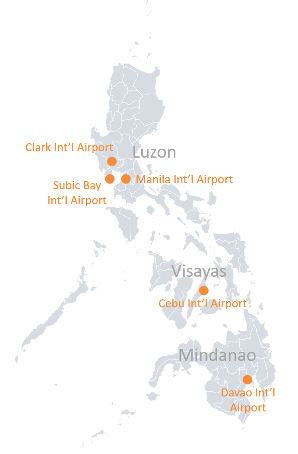
- Ninoy Aquino International Airport (MNL) in Manila, the country’s primary international cargo gateway
- Clark International Airport (CRK), increasingly attractive due to infrastructure expansion and reduced Metro Manila congestion
- Mactan-Cebu International Airport (CEB), serving the Visayas region with growing international connectivity
- Davao International Airport (DVO), supporting Mindanao exports
- Subic Bay International Airport (SFS), serving the Subic Bay Freeport Zone
Clark and Cebu are becoming viable alternatives to Manila for companies seeking to avoid congestion risk, particularly during peak seasons for electronics and retail cargo.
Key Ocean Freight Gateways
Ocean freight Philippines remains essential for higher-volume cargo and cost-efficient regional distribution. Major seaports include: 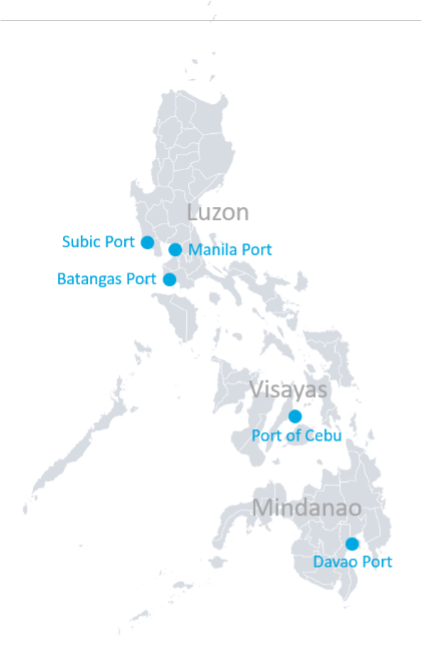
- Port of Manila, the primary gateway for containerized trade with connections to major carrier services across Asia, the Americas, Europe, and the Middle East
- Batangas Port, an alternative to Manila for southern Luzon cargo
- Cebu Port, serving Central Philippines and operating as a secondary international hub
- Subic Port, offering deepwater access with lower congestion and well-suited for breakbulk, project cargo, and oversized shipments
- Davao Port, serving Mindanao and supporting agricultural and industrial exports
Because of the Philippines’ archipelagic geography, inter-island shipping is also a meaningful part of the country’s logistics network.
Efficient coordination between ocean freight, trucking, and domestic distribution is often required for cargo originating outside Metro Manila.
Working with a freight forwarder that manages both international and domestic legs, rather than just the port-to-port segment, reduces handoff gaps and keeps transit predictable.
Logistics Advantages of Shipping from the Philippines
Strong Electronics and Semiconductor Ecosystem. The Philippines remains one of Southeast Asia’s most established electronics manufacturing centers, supporting consistent demand for air freight Philippines services and specialized handling for high-value, time-sensitive cargo.
Growing Alternative Gateways. Clark, Cebu, and Subic provide routing flexibility outside of Manila, helping shippers reduce congestion risks and improve cargo planning during peak periods.
Strategic Access to the US Market. The Philippines maintains strong trade connectivity with the United States, making it an important export location for electronics, industrial goods, and consumer products under existing trade frameworks.
PEZA and Economic Zone Advantages. The Philippine Economic Zone Authority (PEZA) supports export-oriented manufacturing through a network of special economic zones across the country. PEZA-registered companies benefit from streamlined customs procedures, duty-free importation of raw materials, and simplified export processing, all of which reduce landed costs and accelerate clearance timelines.
Regional Supply Chain Flexibility. The Philippines supports broader Asia-Pacific logistics strategies through multimodal connectivity and transshipment options via regional hubs including Singapore, Hong Kong, Taipei, and Seoul.
PEZA Accreditation and What It Means for Your Logistics Partner
PEZA accreditation is not just a shipper advantage. It also matters for your logistics partner.
Working with a Philippines freight forwarder that holds PEZA accreditation means smoother coordination on zone entry and exit, access to after-hours cargo release arrangements, and direct engagement with Bureau of Customs processes that non-accredited providers cannot offer.
Dimerco’s Philippines, which have been active since 1978, hold PEZA accreditation alongside CTPAT and IATA certifications.
With offices in Metro Manila, Cebu, and Subic Bay, the team supports both zone-based and general import/export freight, including after-hours backdoor releasing for consignees located inside economic zones, a capability that matters when production schedules cannot wait for standard clearance hours.
These accreditations reflect the compliance standards that major electronics and semiconductor shippers require, and the depth of integration needed to execute reliably in this market.
Important Considerations When Shipping from the Philippines
Shipping from the Philippines is not without its complexities. Shippers should plan for:
- Typhoon season disruptions: the Philippines experiences peak typhoon activity between June and November, which can affect port operations and trucking in affected regions. Building buffer time into shipment schedules during this period is standard practice.
- Port and airport congestion, particularly at Manila’s main terminals during peak electronics and retail shipping seasons. Early booking and alternative gateway planning through Clark, Cebu, or Subic can help mitigate this.
- Customs documentation accuracy: clearance for bonded consignees typically takes one to two business days. For non-bonded consignees, the process takes three to five working days when documentation is complete. Errors or incomplete documents extend these timelines and can trigger storage charges.
- Metro Manila traffic conditions: last-mile delivery in and around Metro Manila requires careful scheduling, particularly for time-critical cargo.
- Inter-island coordination requirements: cargo originating outside Luzon requires domestic transshipment planning in addition to international freight coordination.
- Peak season capacity tightness: air freight Philippines capacity tightens significantly during the Q4 electronics peak. Advance capacity booking with established carrier relationships is essential.
Shipper’s Take Away
Shipping from the Philippines is a legitimate strategic option, not a fallback.
The country has the manufacturing base, the infrastructure, the trade relationships, and the regulatory frameworks to support serious logistics operations. The gap has been one of awareness, not capability.
The practical requirements, including PEZA compliance, customs clearance processes, inter-island coordination, and typhoon season planning, are manageable with the right partner.
Shippers that understand these dynamics early avoid the delays and cost overruns that come from underestimating them.
Are you are evaluating the Philippines as part of a regional supply chain strategy, or already operating there and looking for stronger logistics execution? Start a discussion with us!
