
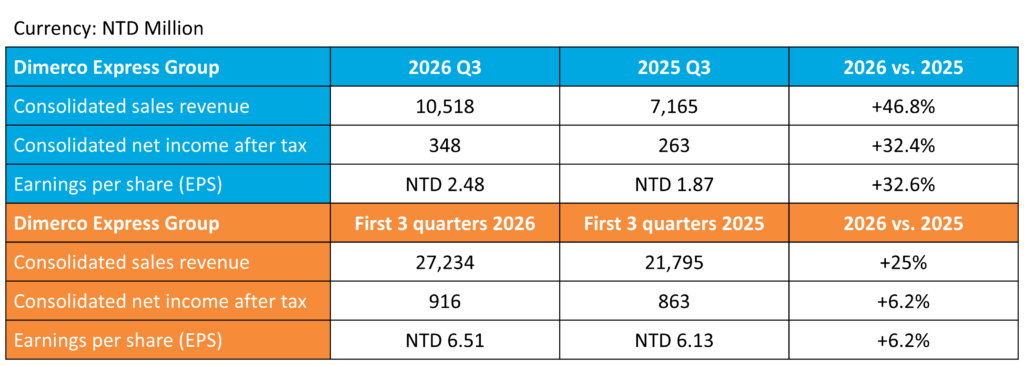
Dimerco Express Group (5609) today announced that its Board of Directors approved the consolidated financial statements for the third quarter of 2026, reviewed by external auditors. Third-quarter consolidated revenue totaled NT$10.518 billion, up 46.8% year over year. Net income after tax increased 32.4% to NT$348 million, while earnings per share (EPS) rose 32.6% to NT$2.48.
For the first three quarters of 2026, the Group reported consolidated revenue of NT$27.234 billion, an increase of 25% compared with the same period last year. Consolidated net income after tax of NT$916 million, representing year-over-year growth of 6.2%, while cumulative earnings per share reached NT$6.51, up 6.2% year over year.
During the third quarter, the global logistics market continued to be affected by geopolitical developments, tariff policies, and supply chain restructuring, resulting in varying demand across market segments. Strong shipment demand from the AI, semiconductor, and high-tech industries, with customers’ adjustments to their global production and supply chain networks, drove increased demand for cross-regional transportation and integrated logistics services, serving as key drivers of the Group’s growth.
In terms of profitability, fluctuations in energy prices, aviation fuel costs, freight rates, and related surcharges pushed up overall logistics costs. Meanwhile, Dimerco continued to invest in talent development, employee training, and cross-regional collaboration to support business growth and global operations, resulting in higher operating expenses compared with the same period last year. These investments help strengthen the global team’s ability to jointly develop business and serve customers, laying a solid foundation for future growth and profitability.
High-Tech Expansion Drives Greater Cross-Regional Logistics Demand
In air freight, demand from the AI, semiconductor, and high-tech industries remained a major growth driver for the Asia-Pacific logistics market. During the third quarter, export demand from Taiwan and other major high-tech manufacturing hubs across Asia stayed strong, driving increased demand on routes to the US and intra-regional routes. Capacity remained relatively tight on certain routes due to capacity allocation and seasonal demand.
High-tech companies in Taiwan and across Asia continued to expand their investments in the US and Southeast Asia, driving cross-border transportation demand for production equipment, components, and high-tech products, as well as local warehousing, contract logistics, and integrated supply chain services.
In ocean freight, demand on trans-Pacific routes remained firm, while carriers continued to respond to market supply and demand changes through blank sailings and capacity adjustments. Adjustments to intra-Asia trade and manufacturing supply chains also supported regional ocean freight demand. Capacity availability and freight rate trends vary across routes, reflecting changes in the global trade environment and end-market demand.
Regarding international trade policies, U.S. tariff measures and trade compliance requirements continued to affect companies’ global supply chain strategies and import-export operations. As tariff policies, origin determinations, and import declaration requirements keep evolving, companies are facing growing needs for customs management, trade compliance, and supply chain risk management.
As global supply chains continue to adjust, Dimerco integrates its capabilities in air freight, ocean freight, multi-transportation, contract logistics, trade compliance, and supply chain design to help customers navigate production base relocations, cross-regional transportation, and supply chain management requirements while balancing costs, transit times, and risks.
Expanding AI and Digital Applications to Improve Operational Efficiency and Service Value
As global supply chains continue to evolve rapidly, Dimerco is accelerating its AI and digital transformation initiatives, progressively introducing artificial intelligence and automation technologies into core operational processes including booking, shipment milestone updates, accounting, and warehouse operations.
As the scope of these applications has expanded, the proportion of automated processes across Dimerco’s major global operations increased from about 17% in early 2025 to approximately 29% in October 2026. Automation is also gradually evolving from individual task-level applications toward more integrated end-to-end operational processes, helping improve both operational efficiency and service quality.
Dimerco is also continuing to develop teams with strong professional expertise, digital capabilities, and adaptability. Through digital tools and data applications, the company is strengthening cross-regional collaboration while improving information transparency, decision-making efficiency, and customer service capabilities.
Sound Financial Structure Highlights the Strength of Dimerco’s Asset-Light Model
Dimerco has long maintained a disciplined approach to customer quality and financial management, supporting a sound financial structure and strong operational flexibility. As of September 30, 2026, Dimerco reported a current ratio of 2.43, reflecting a healthy liquidity. Fixed assets accounted for 8% of shareholders’ equity, highlighting the flexibility of its asset-light operating model. Total liabilities represented 38.1% of total assets, underscoring the company’s overall sound and stable financial position.
Outlook
Looking ahead, the global logistics market will continue to be influenced by tariff policies, geopolitical developments, energy prices, capacity allocation, and changes in end-market demand. As global supply chains continue to restructure and the AI, semiconductor, and high-tech industries continue to expand, demand for cross-regional logistics integration, supply chain visibility, and risk management is expected to remain strong.
Dimerco will further strengthening its global service network and deepening customer partnerships by combining cross-regional logistics integration, trade compliance, and digital supply chain management capabilities. These efforts will help customers navigate changes in global supply chains, improve logistics efficiency and operational resilience, and capture long-term business opportunities arising from the growth of AI and high-tech industries and the ongoing restructuring of global supply chains. The company aims to sustain long-term growth momentum.
Spokesperson: Jack Ruan +886 921-062500 / +8862 2796-3660#222
Find out more on Financial Overview