
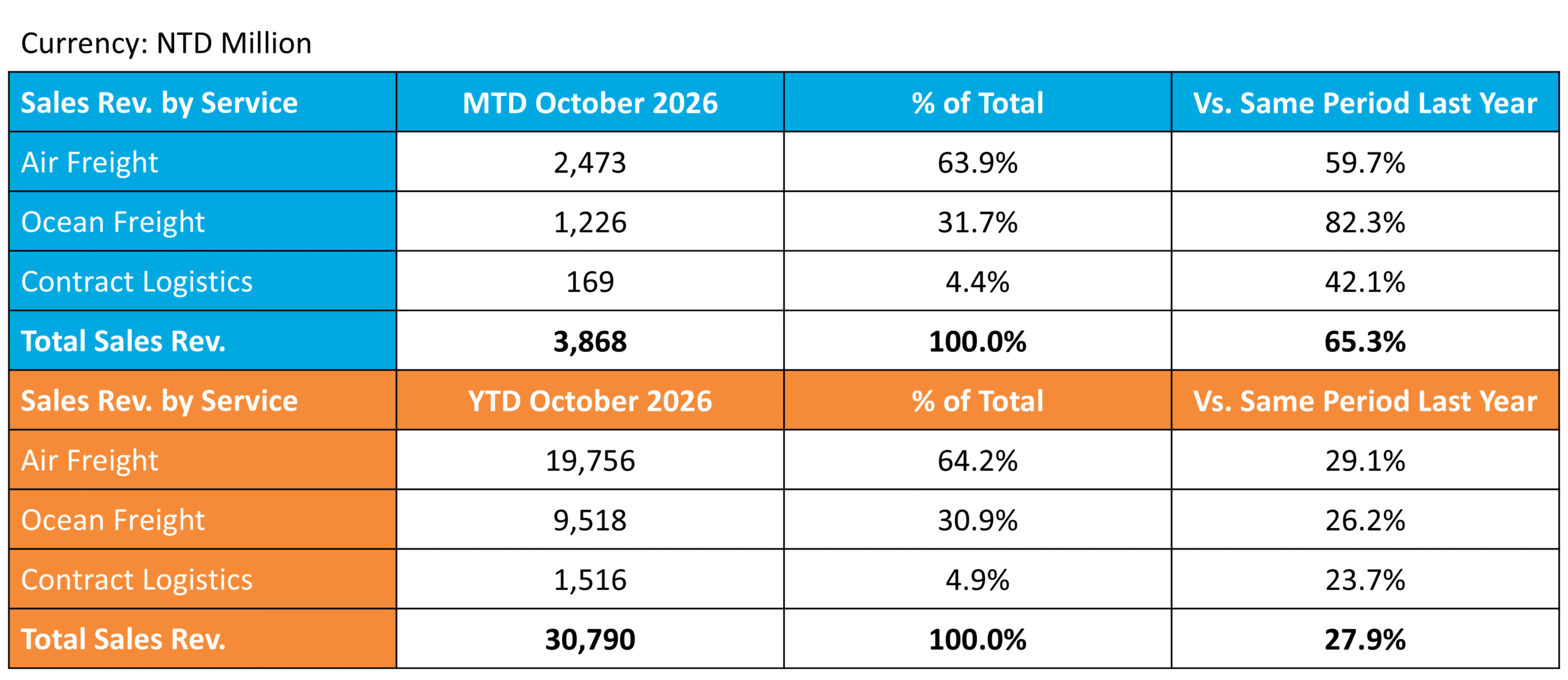
Dimerco Express Group (TWSE: 5609) announced that its consolidated revenue for October 2026 reached NT$3.868 billion, up 65.3% year on year and marking the highest monthly revenue since May 2022. Supported by logistics demand from the semiconductor, AI server, and high-tech with the traditional peak freight season in the fourth quarter, air freight revenue increased 59.7% year on year, ocean freight revenue grew 82.3%, and contract logistics revenue rose 42.1%. Dimerco continued to leverage its global supply chain management capabilities and cross-regional logistics services to help customers meet capacity requirements and navigate changes in global supply chains.
For the first ten months of 2026, Dimerco’s consolidated revenue reached NT$30.79 billion, representing a 27.9% increase from the same period last year. Global supply chains continue to undergo adjustments, while market demand varies across industries. Shipments from the AI, semiconductor, and high-tech remain key drivers of logistics demand, supporting cross-regional transportation and integrated supply chain services.
October marked the beginning of the traditional fourth-quarter peak freight season, with AI hardware, electronic products, and year-end retail inventory replenishment supporting freight demand. Some Asia-US airfreight remained strong, making capacity arrangements more challenging during the peak season. Winter schedule adjustments may also affect belly cargo capacity of certain passenger flights.
In ocean freight, demand on trans-Pacific routes remained steady, while carriers continued to adjust capacity and implement blank sailings in response to market conditions. Some intra-Asia have tightened with capacity reallocation. On the U.S. West Coast, PMA and ILWU Local 26 have extended their negotiation deadline to midnight on November 6, 2026 (Pacific Time). Negotiations will resume Friday with assistance from the Federal Mediation and Conciliation Service. A new labor agreement has not been reached. If negotiations fail and a strike occurs, six LA/LB container terminals may be potentially affected. According to PMA, these facilities handle approximately 85% of Long Beach cargo and 33% of Los Angeles cargo. The labor dispute comes amid heavy holiday merchandise arrivals, existing congestion and elevated rail container dwell times. Possible impacts include of vessel, yard, and gate disruptions, delayed cargo pickup and delivery and additional demurrage and detention exposure. On Asia-Europe, some carriers have resumed services through Suez, while capacity and freight rate trends continue to vary depending on routes and carrier arrangements.
Regarding international trade policies, U.S. tariff measures and trade compliance requirements continue to affect companies’ global supply chain strategies and import-export operations. According to fiscal year 2025 enforcement statistics released by CBP, collections from importer audits totaled US$235.46 million, approximately double the previous fiscal year’s amount. Collections from penalties and liquidated damages reached US$46.04 million, representing an increase of about 76% year over year. Companies should ensure that country-of-origin declarations and claims for preferential treatment under free trade agreements are supported by complete, traceable supply chain and manufacturing records linked to specific products and production batches. They should also establish procedures with suppliers in advance to obtain the necessary documentation, minimizing inspection delays and additional costs.
In October, the U.S. Court of International Trade certified an importer class action lawsuit involving tariffs imposed under IEEPA. However, class certification does not mean that the court has ordered refunds. Subsequent arrangements will depend on court orders and guidance from CBP. Meanwhile, certain tariffs imposed under Section 301 remain in effect, and companies should monitor applicable tariff measures, import declarations, and related compliance requirements.
Looking ahead, geopolitical developments, trade policies, and changes in capacity allocation will continue to shape global supply chains. Demand for cross-regional logistics integration, transportation flexibility, and supply chain visibility remain strong. Dimerco will continue to integrate air freight, ocean freight, multi-transportation, and local logistics services, while leveraging digital solutions and supply chain management capabilities. Through these efforts, Dimerco aims to help customers improve logistics efficiency, strengthen supply chain resilience, capture opportunities arising from the growth of AI and high-tech industries and the ongoing restructuring of global supply chains.
Spokesperson: Jack Ruan +886 921-062500 / +8862 2796-3660#222
Find out more on Financial Overview