
If you import goods into the US, you’re likely paying Merchandise Processing Fees (MPF) on nearly every shipment. While the fee may seem small at first glance, it adds up quickly, especially for companies running high-frequency global supply chains.
For many importers, MPF is a hidden cost driver that quietly erodes margins. The good news is that with the right supply chain design, you can significantly reduce—or even eliminate—these fees.
In this article, we’ll break down how MPF works, and more importantly, how to reduce it through smarter shipping strategies, Foreign Trade Zone (FTZ) optimization, and Free Trade Agreement (FTA) utilization.
What is the Merchandise Processing Fee (MPF)?
MPF is a fee assessed by the US Customs and Border Protection (CBP) on most imports entering the United States. It is designed to cover the administrative cost of processing shipments through customs.
For formal entries, MPF is calculated as:
- 0.3464% of the declared value
- Subject to a minimum (approximately $31)
- Capped at a maximum (approximately $600)
The key detail is that MPF is charged per customs entry, not per container, SKU, or unit.
That distinction creates opportunities to reduce total landed cost when shipments are structured correctly.
Why MPF Matters More Than You Think
At low volumes, MPF may not seem significant. But for companies shipping frequently from Asia to the US, it becomes a major cost factor.
Consider a typical high-tech manufacturer with weekly shipments from Asia. Paying the capped MPF multiple times per week can result in tens of thousands of dollars in annual costs that don’t add any value to the business.
For logistics leaders under pressure to control costs while maintaining service levels, optimizing MPF is a practical and high-impact opportunity.
Strategy 1: Consolidate Shipments to Reduce Entry Frequency
Because MPF is charged per entry, reducing the number of entries is one of the simplest ways to lower total cost.
Example:
- 4 shipments per month at $250,000 each
- Each shipment hits the MPF cap ($600)
- Monthly MPF: $2,400
Now compare that to consolidation:
- 1 shipment per month at $1,000,000
- MPF is still capped at $600
- Monthly MPF: $600
That’s a 75% reduction in the MPF expenses.
Trade-offs:
Fewer shipments increase inventory holding costs and reduce flexibility. That’s why most companies adopt a hybrid approach by consolidating where possible while maintaining service levels.
Where Dimerco adds value
Dimerco helps you design shipment cadence based on total landed cost, not just freight rates. By aligning consolidation strategies with demand patterns, we help you reduce MPF without compromising supply chain performance.
Strategy 2: Optimize FCL vs LCL Decisions
MPF also influences the decision between full container load (FCL) and less-than-container-load (LCL). FCL shipments typically result in one customs entry, whereas LCL shipments often result in multiple entries
Even if LCL appears cheaper from a freight perspective, multiple MPF charges can increase the total landed cost.
Multiple LCL shipments in a month will result in multiple MPF charges, compared to a single FCL shipment charged a single capped MPF.
As shipment value increases, the effective MPF rate decreases due to the cap. This makes FCL more attractive at lower volume thresholds than many companies expect.
Where Dimerco adds value
Dimerco evaluates FCL vs. LCL decisions holistically, factoring in MPF, transit time, and inventory impact. This ensures you’re making decisions based on total cost, not just transportation cost.
Strategy 3: Use Foreign Trade Zones (FTZs) and Weekly Entry
One of the most powerful ways to reduce MPF is through the strategic utilization of FTZs, weekly entry provisions, and customs-bonded warehouses.
An FTZ is a specially designated site near a US port of entry that permits companies to move goods in and out of the country, which will reduce or eliminate customs duties, taxes, or fees. Imported goods entering an FTZ are treated as if they are outside of US Customs territory for duty purposes. Goods can be kept in an FTZ indefinitely, and limited value-added services can be performed before export. A customs-bonded warehouse offers similar advantages under a different set of regulations.
Both an FTZ and a customs-bonded warehouse allow you to receive and store inventory without incurring duties and taxes until items are sold and released. FTZs offer unique benefits for reducing import costs, including the MPF.
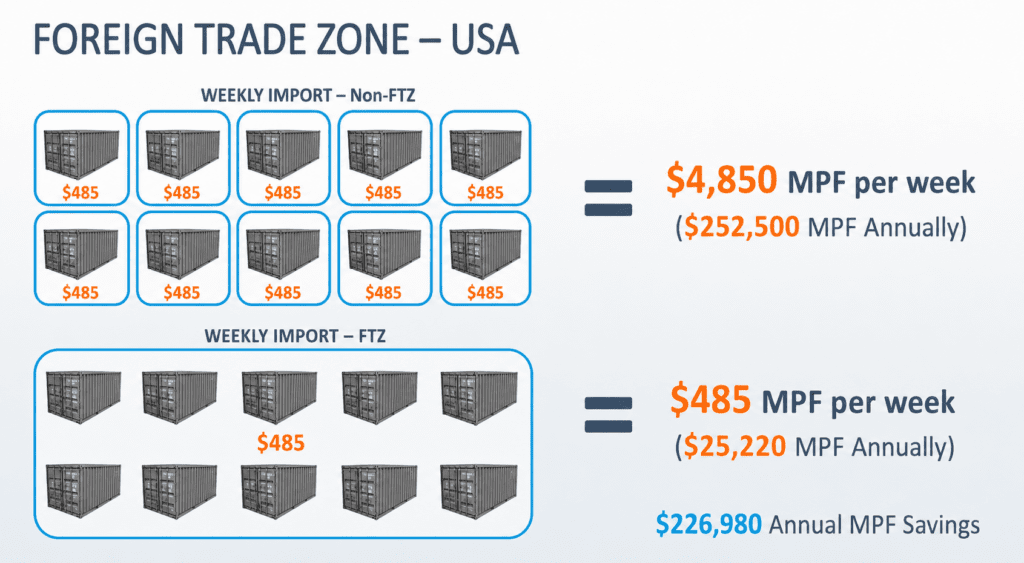
For goods held outside an FTZ, importers pay the MPF on every shipment as it enters the country. For goods shipping into an FTZ, multiple shipments can be combined into a single weekly customs entry rather than separate entries for each import transaction, as in a non-FTZ warehouse.
The MPF and duties are assessed only once a week under the weekly entry provision based on the past seven days of export activity. You don’t pay duties until the cargo is sold and shipped to your customers.
FTZ Savings Example
3 Benefits of Using FTZs
Reduction: MPF fees are directly reduced by using Estimated Weekly Entries.
Deferral: Duty isn’t paid to CBP until the cargo is sold and shipped from the FTZ. The Harbor Maintenance Fee (HMF) is paid quarterly, not as cargo arrives.
Avoidance: By exporting from the FTZ, duty and MPF are eliminated.
Where Dimerco adds value
Dimerco helps manage your FTZ operations, compliance, and weekly entry processes to ensure maximum savings.
Strategy 4: Align Multi-Origin Supply Chains (China Plus One)
Many companies are adopting China Plus One strategies to diversify sourcing. However, splitting production across multiple countries can increase the number of shipments and, therefore, MPF exposure.
Without coordination, separate shipments from each origin result in multiple entries and a higher total MPF
In contrast, an optimization approach consolidates shipments at the origin or regional hubs, synchronizes shipping schedules and uses FTZs to combine entries.
Where Dimerco adds value
With a strong Asia-Pacific network, Dimerco coordinates multi-origin shipments across China, Southeast Asia, and beyond. This allows you to diversify sourcing while maintaining cost efficiency.
Strategy 5: Eliminate MPF with Free Trade Agreements (FTAs)
The most powerful way to reduce MPF is to eliminate it entirely. MPF is waived for qualifying goods under Free Trade Agreements such as the USMCA or the US–Australia FTA. Under the FTAs, qualifying goods are not assessed duties for MPF.
To qualify, goods must meet rules of origin requirements, which may include:
- Regional Value Content thresholds
- Tariff shift rules
- Substantial transformation
Simply shipping from a country does not guarantee qualification.
Example:
- $500,000 shipment
- Without FTA: Duty + MPF = $25,600
- With FTA: Duty = $0, MPF = $0
How to use FTAs to eliminate MPF
Design sourcing and manufacturing to meet origin rules
- Validate qualification at the SKU level
- Maintain accurate documentation and certification
- Align the importer of record and Incoterms
Combine FTAs with FTZs
FTZs provide flexibility to evaluate qualification before entry. If goods qualify, you eliminate duty and MPF. If not, you still benefit from weekly entry optimization.
Where Dimerco adds value
Dimerco integrates trade compliance with logistics execution. We help you align sourcing strategies with FTA qualification, manage documentation, and ensure accurate entry filing, so you capture every available cost-saving opportunity.
Dimerco’s Landed Cost Strategy For MPF
Reducing MPF isn’t about a single tactic – it’s about designing your supply chain holistically. The most effective strategies combine:
- Shipment consolidation
- FCL optimization
- FTZ and weekly entry utilization
- Multi-origin coordination
- FTA qualification
For high-speed supply chains, the challenge is balancing cost reduction with service requirements. You need to maintain inventory availability, avoid delays, and respond quickly to changes in demand, all while controlling costs.
Dimerco connects Asia with the world like no other global 3PL. We integrate air and ocean freight, trade compliance, and contract logistics services to make your supply chain faster, more flexible, and more cost-efficient.
Our approach goes beyond transportation. We work with you to:
- Design shipment strategies that reduce MPF and total landed cost
- Coordinate multi-origin supply chains across Asia
- Manage FTZ operations and weekly entry processes
- Ensure compliance with FTA requirements and documentation
- Provide visibility and control through a unified global platform
Because in today’s environment, success isn’t just about moving freight – it’s about building a smarter, more efficient supply chain.
Why Focus on MPF
MPF may seem like a minor line item, but its impact is significant—especially for companies with frequent shipments and complex global supply chains.
By rethinking how and when you create customs entries, and by leveraging tools like FTZs and FTAs, you can dramatically reduce – or even eliminate – these fees.
The opportunity is there. The key is having the right strategy – and the right partner to execute it.
To learn more about managing MPF expenses for your company, connect with a Dimerco Specialist.
