
Hong Kong has long served as one of Asia’s most important logistics gateways, connecting manufacturers and suppliers across Greater China with global markets. With world-class port infrastructure and one of the world’s busiest air cargo airports, Hong Kong remains a critical hub for high-value and time-sensitive shipments to the US.
For businesses exporting electronics, consumer products, or industrial components, understanding the shipping process, transit times, and customs requirements is essential to maintain efficient shipping from Hong Kong to the US.
Why Companies Ship from Hong Kong to the US
Hong Kong has long served as a strategic gateway connecting Asia’s manufacturing base with the USA. In 2025, exports from Hong Kong to the US exceeded USD 41 billion, underscoring the continued importance of this trade lane.
Several key advantages continue to make Hong Kong a preferred export hub for US-bound shipments:
Free Port Advantage – Hong Kong operates as a free port with minimal customs barriers, no VAT, and efficient export procedures, making it an attractive consolidation point for regional exports. These advantages help businesses reduce administrative complexity and accelerate global shipments.
Strong Airline Connectivity – Hong Kong International Airport’s extensive airline network provides strong routing flexibility, particularly during peak seasons or capacity constraints, making it a preferred gateway for high-value shipments.
Neutral Business Environment – Hong Kong’s stable regulatory environment and well-established logistics ecosystem further support its role as a preferred shipping hub for US-bound shipments.
Together, these advantages make Hong Kong a reliable export gateway for companies across Southern China and Asia, particularly when speed, flexibility, and global connectivity are critical.
Learn more about why businesses choose to ship from Hong Kong .
Shipping Time from Hong Kong to the US: Air vs Ocean Freight
For businesses shipping from Hong Kong to the US, the choice between air and ocean freight depends largely on urgency, shipment size, and cargo value.
Air freight is typically preferred for high-value or time-sensitive goods such as semiconductors, electronics, and industrial components.
Transit times generally range from 2 to 5 days airport-to-airport and 3 to 7 days door-to-door.
As one of the world’s leading air cargo hubs, Hong Kong offers frequent direct and connecting flights, providing routing flexibility during peak seasons and periods of constrained capacity to major US gateways, supporting faster and more flexible delivery options.
For bulk or non-urgent shipments, ocean freight provides a more economical solution.
Transit times typically range from 14–20 days to the US West Coast and 25–40 days to the East Coast, with an additional 5–10 days for door delivery, depending on inland transportation and customs clearance.
Ocean freight is commonly used for larger shipments such as machinery, industrial materials, and consumer goods, where cost efficiency is prioritized over speed.
| Air Freight | Air freight | Ocean Freight | |
|---|---|---|---|
| Best for | Urgent or high-value cargo | 24-48 hours | Non-urgent or low-value cargo |
| Cost | Premium | Higher | Economical |
| Transit Time (Port) | 2-5 Days | Affected by flight schedules / cargo space availability | USWC: 14 – 20 days USEC: 25 – 40 days |
| Transit Time (Door) | 3-7 Days | Urgent, high-value cargo | Additional 5 – 10 days |
How to Reduce Shipping Costs from Hong Kong to the US
Beyond transit time, shipping cost is another key consideration when planning shipments from Hong Kong to the US.
This can vary significantly depending on routing, shipment size, and urgency.
Some of the common cost-saving approaches include selecting the right transport mode, consolidating shipments, and optimizing packaging to reduce chargeable weight.
These strategies are particularly effective when shipping high-value or time-sensitive goods from Hong Kong, where multiple routing and consolidation options are available.
- Choose the Right Mode and Coast – Shipping via ocean freight to the US West Coast is typically more economical and faster than routing to the East Coast. For urgent shipments, air freight from Hong Kong offers frequent departures and competitive options during capacity fluctuations.
- Leverage Hong Kong for Regional Consolidation– Cargo from Southern China or across Asia can be consolidated in Hong Kong to increase shipment size, improve rate negotiation, and reduce per-unit shipping costs.
- Optimize Chargeable Weight for Air Freight – For high-value electronics and semiconductor shipments commonly routed via Hong Kong, optimizing packaging and reducing volumetric weight can significantly lower air freight costs. Learn more on the strategies to reduce international airfreight costs.
- Plan Around Peak Seasons and Capacity Constraints – Shipping ahead of peak periods, such as holiday seasons or end-of-quarter demand, can help avoid surcharges and rate volatility on Hong Kong-US routes.
By following these strategies, companies shipping from Hong Kong to the US can reduce overall transportation costs while maintaining supply chain efficiency.
For more cost-reduction strategies, explore How to Reduce International Shipping Costs – 10 Strategies.
Cross-Border Trucking via Hong Kong: A Gateway for Southern China
Beyond direct exports, Hong Kong’s role as a logistics gateway is further strengthened by its cross-border connectivity with mainland China manufacturing hubs.
Hong Kong plays an important role in cross-border trucking operations for neighbouring manufacturing regions, particularly across Southern China and other parts of mainland China.
Many companies transport cargo by truck from factories in mainland China to Hong Kong, where shipments are consolidated and exported to the US.
Hong Kong’s proximity to major manufacturing provinces such as Guangdong (including cities like Shenzhen, Dongguan, and Guangzhou) allows cargo to move efficiently via cross-border trucking.
Shipments can often move from factories to Hong Kong within hours, enabling exporters to take advantage of more frequent air and ocean freight departures and faster export handling compared to mainland China gateways.
Cross-border trucking between mainland China and Hong Kong offers several advantages:
- Favorable Customs and Tariff Treatment
- Faster access to Hong Kong’s global air and ocean freight capacity
- Flexible consolidation from multiple factories across Southern China
- Efficient export handling through Hong Kong’s free-port environment
- Greater routing flexibility for time-sensitive shipments
This approach is commonly used for industries such as semiconductors, electronics, and high-value components, where speed and reliability are critical.
Learn more about the advantages of Hong Kong as a trans-shipment hub for South China manufacturers.
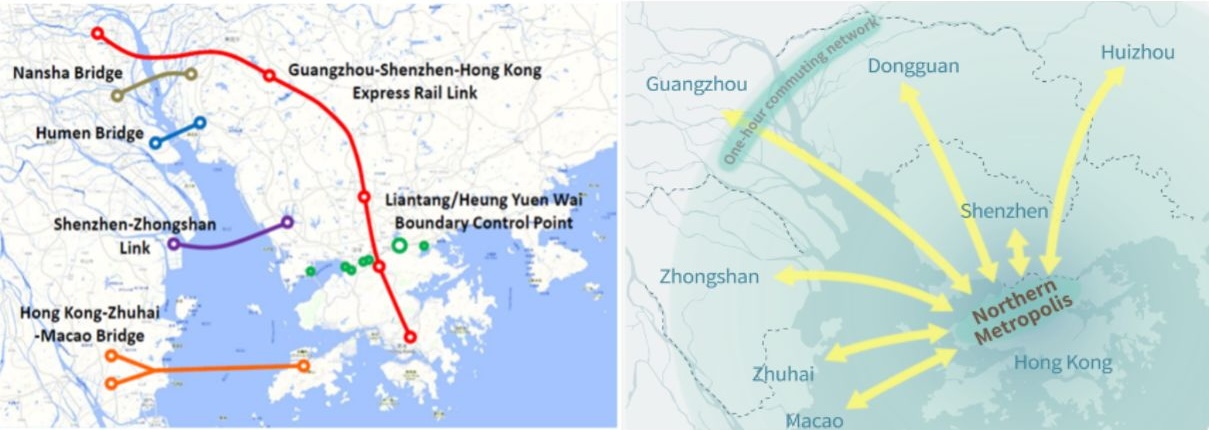
Beyond Southern China, cross-border trucking can also support cargo movements from other regions in mainland China, depending on urgency and logistics planning.
This flexibility allows Hong Kong to function as a regional logistics gateway, connecting mainland China manufacturing hubs with global markets, including the US.
Using Hong Kong as an Asia Transshipment Hub
Aside from China-origin cargo, other neighbouring Asian countries also utilize Hong Kong as a transshipment hub to leverage its strong air cargo capacity and global connectivity.
When direct flights are constrained in origin markets, routing via Hong Kong provides additional flexibility and access to more frequent US-bound connections.
Hong Kong International Airport (HKIA) supports this role with around 140 airlines, over 1,100 daily flights, and connections to nearly 200 destinations worldwide.
This extensive network allows cargo from Southeast Asia and other parts of Asia to be consolidated in Hong Kong and quickly routed to the US, particularly for high-value and time-sensitive shipments such as semiconductors, electronics, and industrial components.
Hong Kong International Airport has ranked as the world’s busiest international cargo airport multiple times, reinforcing its role as a regional transshipment hub for US-bound cargo.
This makes Hong Kong particularly valuable during peak shipping seasons, capacity shortages, or supply chain disruptions that affect direct routes to the US from other airports in the region.
Companies across Southeast Asia, Southern China, and the Greater Bay Area frequently leverage Hong Kong as a consolidation point for US-bound shipments.
Case Study: Expediting US-Bound Semiconductor Shipping via Hong Kong
A leading US-based semiconductor manufacturer required an urgent shipment from Manila to Los Angeles.
The customer’s usual routing via Taiwan was expected to arrive on August 26, but the shipment timeline needed to be accelerated.
Leveraging Hong Kong as a transshipment hub, Dimerco utilized the airport’s strong flight options and efficient cargo handling to reroute the shipment.
The cargo arrived in Los Angeles on August 22, saving four full days and supporting production continuity.
US Import Requirements When Shipping from Hong Kong
When shipping goods from Hong Kong to the US, exporters must comply not only with Hong Kong export requirements, but also with US import regulations, including customs classification, documentation, and now important tariff considerations as defined by US trade policy.
You must use the Harmonized Tariff Schedule (HTS) code, which is the US-specific version of the HS code, to determine the correct duties.
Always ensure you classify your products accurately using the HTS to avoid delays and penalties.
Two key filings must be completed by your freight forwarder before cargo arrives at US ports:
- Automated Manifest System (AMS) – Required for all shipments.
- Importer Security Filing (ISF) – Required for ocean freight shipments only.
Choose a CTPAT-Certified Forwarder
 For hassle-free customs clearance, consider working with a freight forwarder, like Dimerco Express Group, that is CTPAT-certified. A CTPAT-certified freight forwarder offers faster customs clearance, reduced inspection risk, enhanced cargo security, and greater credibility in global trade. Dimerco USA has held this certification for decades and ensures that every shipment meets US Customs and Border Protection standards
Shipping from Hong Kong to the US: Does Your Freight Forwarder Have the Right Stuff?
As shipping expectations rise for speed, compliance, and flexibility, not all logistics partners are equipped to manage Hong Kong’s complex cross-border environment. Limited scale, network coverage, or regulatory expertise can lead to delays, higher costs, and operational risks. Choosing an experienced partner with strong local capabilities is therefore critical when shipping from Hong Kong to the USA. When evaluating logistics providers, look for:
- Cross-Border Expertise – Experience managing China–Hong Kong trucking, customs clearance, and integrated air, ocean, and land transport, including models such as the Hong Kong U-Turn Strategy.
- Strong Compliance Capabilities – Expertise in AEO programs, dangerous goods handling, and lithium battery regulations to ensure secure, compliant shipments. Dimerco holds top-tier AEO certification in China and operates TAPA-certified facilities in Hong Kong, supporting secure and efficient cross-border logistics.
- Established Hong Kong Presence – Local warehousing, transshipment capabilities, and strong relationships with airlines, HKIA, and customs authorities.
- Integrated Technology Platforms – Real-time tracking, digital documentation, and analytics for improved visibility and cost control.
- Multimodal Flexibility – Ability to combine air, ocean, and trucking solutions to balance speed, cost, and reliability.
Need Help Shipping from Hong Kong to USA?
Working with an experienced logistics partner like Dimerco helps businesses evaluate routing options, manage cross-border trucking, and optimize transit times when shipping from Hong Kong to the US. Looking to explore the most effective shipping strategy from Hong Kong to the US? Start a discussion with us.
