
As China+1 strategies accelerate, Thailand has emerged as a key Southeast Asia gateway. However, companies without a local entity often face compliance challenges around customs, ownership transfer, and foreign exchange settlement. Thailand One-Day FTZ (Free Trade Zone) Transit model offers a structured option to address these issues. This article outlines how the model works, its limitations, and when it may be relevant.
What Is the Thailand One-Day FTZ Transit Model?
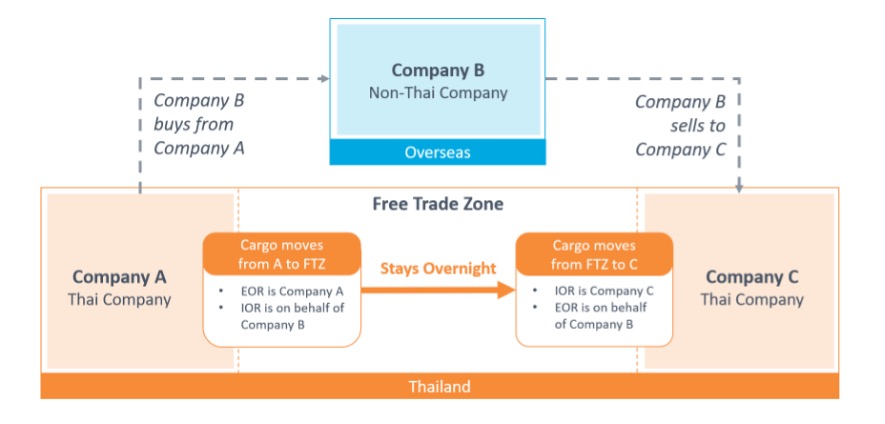
Under this model, goods are imported into a Thailand Free Trade Zone and re-exported without entering the domestic market. While the cargo physically remains in Thailand, the import and export customs processes are completed within the FTZ (Free Trade Zone), allowing for a compliant transfer of cargo ownership and related documentation.
In practice, under the Thailand One-Day FTZ Transit arrangement, customs declaration, bonded storage, and ownership transfer can be completed within a short timeframe, often within one day, provided all requirements are met. The model is commonly supported by qualified service providers acting as the Importer of Record (IOR) or Exporter of Record (EOR), enabling foreign companies to operate without establishing a local Thai entity.
Why Companies Consider This Model
1.) Compliant Ownership Transfer – The FTZ framework treats goods entering the zone as “imported” and goods leaving as “exported.” This enables buyers and sellers to complete ownership and payment transfers with full customs documentation, helping ensure the transaction is legally recognized.
2.) Simplified Cross-Border Settlement – Foreign exchange settlement between Thai and non-Thai entities can be complex. Structuring transactions through the FTZ, supported by EOR/IOR arrangements, can help companies align payments with Thai regulatory requirements and improve transparency.
3.) Faster Operational Turnaround – Traditional models may require goods to exit and re-enter the country, adding time and cost. By keeping cargo within the FTZ, companies can complete ownership transfer and redeployment more quickly, improving supply chain responsiveness.
4.) Duty and VAT Deferral – Goods stored in FTZ bonded warehouses can benefit from deferred customs duties and VAT for extended periods (typically up to two years), which may support cash flow management and inventory flexibility.
Operating Scope and Key Rules
To use Thailand One-Day FTZ Transit model effectively, companies need a clear understanding of what activities are permitted within the Free Trade Zone and where regulatory boundaries apply. While the model offers flexibility, it operates under strict customs supervision.
Within the FTZ, companies may store goods in bonded facilities for regional distribution or inventory buffering. Limited activities such as relabelling or repackaging may also be allowed, provided they are properly declared and do not alter the product’s characteristics. For companies without a Thai legal entity, qualified service providers can act as Importer or Exporter of Record, managing customs formalities on their behalf. At the same time, several restrictions are critical to compliance:
- No change to product nature: Import and export HS codes must remain unchanged; processing that alters the product’s essential character is not permitted.
- Repairs require approval: Minor refurbishment may be allowed, but only with prior customs authorization.
- Minimum storage period: Goods must remain in the FTZ warehouse overnight; same-day removal is generally non-compliant.
Typical Use Cases
The Thailand One-Day FTZ Transit model is most relevant for companies that need a compliant, low-commitment way to operate in Thailand or the wider Southeast Asia region. It is commonly used in scenarios where speed, flexibility, and regulatory clarity are priorities. Typical use cases include:
- Companies assessing the Thai or Southeast Asian market before establishing a local entity
- Cross-border e-commerce sellers looking to shorten delivery lead times through regional inventory positioning
- Regional headquarters operating hub-and-spoke distribution models
- Electronics and high-tech companies managing returns, defects, or refurbishment within the region
Choosing the Right Logistics Partner
Execution depends heavily on local regulatory knowledge and operational discipline. Companies exploring this model should look for partners that can provide:
- Customs and compliance oversight to ensure shipments meet Thai regulatory requirements
- End-to-end coordination, covering transport, FTZ warehousing, customs clearance, and EOR/IOR arrangements
- Supply chain advisory support to align inventory placement and routing with business objectives
- Established local networks, including bonded facilities and experienced on-the-ground teams
Case Study: Improving Regional Responsiveness
One electronics manufacturer supplying human–machine interface terminals uses Thailand as a regional staging point for Southeast Asia. Working with Dimerco, an Authorized Economic Operator (AEO) in Thailand, products are pre-positioned in an FTZ warehouse, allowing orders from Thailand and neighboring markets to be fulfilled directly from the region.
Beyond faster delivery, the setup also supports after-sales operations. Defective units can be handled locally, refurbished with customs approval, and returned to circulation—reducing reverse logistics costs while maintaining service continuity. As a result, the company achieved:
- Shorter delivery lead times
- Improved value recovery
- Greater flexibility in managing regional demand
Using FTZ Options as Part of a Broader Strategy
Thailand One-Day FTZ Transit model is not a one-size-fits-all solution, but it can be a useful tool for companies seeking compliant and flexible ways to support Southeast Asia operations under China+1 strategy.
As with any customs-driven model, outcomes depend on careful planning, regulatory alignment, and disciplined execution. With operations in Thailand since 1988, Dimerco combines long-standing local expertise with a global network to support companies evaluating how this model fits their broader supply chain design. Need help in strategizing your business in Thailand? Start a discussion with us.
