For decades, Taiwanese electronics and semiconductor manufacturers built their export strategies around a single-hub model, often a domestic Free Trade Zone (FTZ) feeding global customers directly from Taiwan.
Now, as geopolitical pressures, customer de-risking requirements, and rising FTZ costs reshape regional supply chains, a new strategy is emerging. Many Taiwanese manufacturers in electronics, semiconductors, and AI hardware are shifting warehousing and distribution activities to Singapore and Malaysia.
The appeal is straightforward: mature infrastructure, strong global connectivity, and proximity to fast-growing Southeast Asian markets. But the real story is more nuanced than “move production south.” Successful companies are building a coordinated two-country network, not simply relocating a warehouse. Here’s what’s driving the shift, the policy and compliance forces behind it, and where the strategy can go wrong if it isn’t planned carefully.
From Single-Point Export to a Singapore–Malaysia Dual-Hub Model
Rather than relying on a single high-cost FTZ, many manufacturers are adopting what amounts to a two-country strategy: Singapore as the strategic hub and Malaysia for operations.
Singapore serves as a high-value decision-making, mature specialty chip manufacturing, and financial/compliance center, where corporate structuring, R&D coordination, and specialty chip production take place.
Malaysia, particularly the Penang and Johor corridors, functions as the large-scale land base for outsourced semiconductor assembly and test (OSAT) and physical logistics, with the two markets linked by cross-border trucking that keeps components and finished goods moving. Take advantage of the flexibility between ocean and air freight to balance cost efficiency with transit times.
Because of its unique nature, Singapore has a specific role in this model. Singapore is a regional tech hub purpose-built to serve the Southeast Asian local market and high-value semiconductor and AI hardware supply chains, rather than a location for bulk storage.
Dimerco’s connections across China, Southeast Asia, and Singapore reflect this dual-market model, moving freight between hubs such as Penang and Singapore on a predictable schedule, rather than leaving companies to choose between slow ocean freight and expensive air freight.
Driving Efficiency for a Global Electronics Distributor in Asia
A Fortune 500 global distributor of PCs and technology equipment consolidates mixed freight at distribution terminals in both Singapore and Malaysia, with a key freight loop between a supplier hub in Johor Bahru and Dimerco’s Singapore terminal. Dimerco digitized the warehousing and delivery process, including manifest data integration, mobile scanning, and 24/7 tracking. Distribution cycle time dropped from two days to half a day while maintaining 99.99% accuracy across more than 600,000 cartons. Read the full case study.
The Shift from Costlier FTZ Options
Cost is a major driver of this shift. Traditional FTZs offer duty deferral and manufacturing flexibility, but they come with higher setup costs and heavier regulatory oversight. This overhead burden becomes harder to justify as supply chains diversify across more countries rather than concentrating in a single country.
That’s pushing companies to be more deliberate about matching the storage model to the cargo. A bonded warehouse offers a simpler, less expensive setup ideal for storage, consolidation, and duty deferral, while an FTZ makes more sense when a business needs to actually process or manufacture goods on-site. In Malaysia, Free Commercial Zones (FCZ) offer a similar, more cost-effective alternative to a full FTZ setup, which is why Dimerco’s Malaysian warehouses operate within an FCZ to help customers delay or avoid duty payments without the overhead of a full free trade zone. Choosing the right model, rather than defaulting to the most expensive option, is often the single biggest lever manufacturers have to control warehousing costs in the region.
Policy Tailwinds: Tax Treaties and the Global Minimum Tax
Tax policy is also reshaping the calculus. Taiwan and Singapore signed a new income tax agreement in late 2025 that entered into force on February 13, 2026, and will apply in full starting January 1, 2027, replacing the prior 1981 treaty (Ministry of Foreign Affairs, Taiwan).
Under the new agreement, withholding tax caps on dividends and royalties drop to 10%, and the cap on interest is also set at 10% — a meaningful reduction in cross-border transaction costs for companies moving money between the two markets. Management service fees are now classified under business profits rather than a separate passive-income category, which reduces the risk of double taxation on intercompany service arrangements.
There’s a catch, though. The agreement includes a three-year sunset clause (2027–2029) for indirect tax credits and deemed-paid tax credits, after which those credits stop in 2030 — effectively pressuring Taiwanese businesses to build real local operations rather than lean on credit mechanisms indefinitely.
That local-substance requirement is reinforced by a bigger structural shift: the OECD’s Global Minimum Tax, part of the BEPS 2.0 framework, requires large enterprise groups to maintain an effective tax rate of at least 15% and is now fully implemented in both Singapore and Malaysia.
The old playbook of relying purely on tax holidays no longer works under this regime. Companies now need genuine business substance, including local payroll, tangible asset investment, and a real operational footprint, to legally retain tax benefits. In practice, this means the logistics and warehousing decisions manufacturers make are not only supply chain questions, but they’re also tax strategy questions.
Meeting ESG and Digital Compliance Expectations
Beyond tax policy, global brand customers are placing their own demands on the supply chain. Companies like Apple and Nvidia have strict carbon footprint requirements for suppliers, and Singapore and Malaysia are positioning themselves as APAC leaders in green shipping lanes and low-carbon logistics infrastructure, with Singapore’s Changi Airport ALPS sustainable facilities being one prominent example.
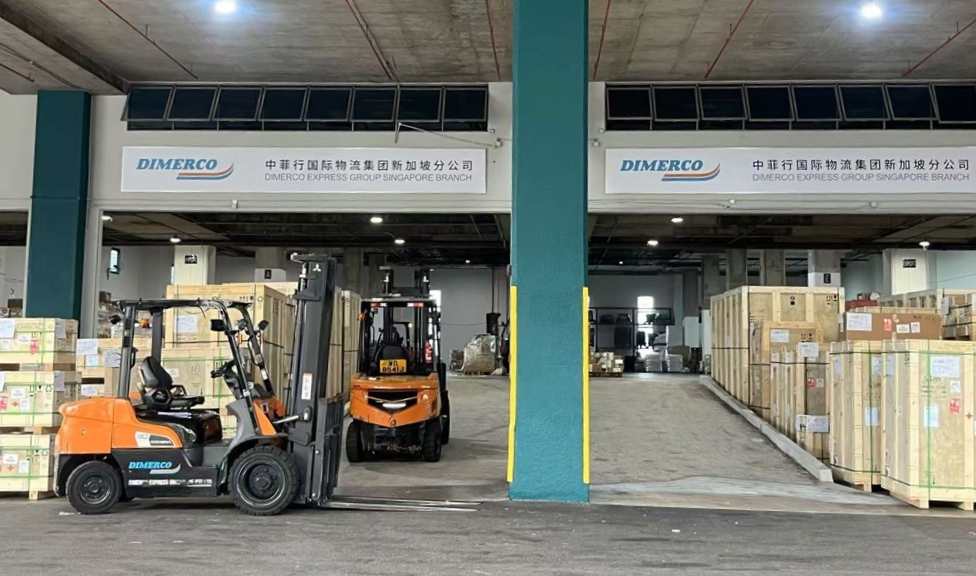
Dimerco’s 35,000-square-foot facility within Singapore’s Airport Logistics Park sits within this ecosystem, built specifically to handle the volumes of AI hardware, semiconductor equipment, and electronics driving demand for specialized, sustainable warehousing in the region.
A less visible compliance requirement is also taking shape: as Malaysia rolls out its national e-invoicing system, corporate ERP and warehouse management systems need to connect closely with local tax authorities. Getting this integration right keeps cash flows, information flows, and physical logistics in sync. Getting it wrong risks penalties that can erode the cost savings the strategy was meant to capture.
Why Singapore and Malaysia’s Industrial Clusters Matter
None of this would matter if the underlying industrial capacity weren’t real. Singapore accounts for roughly 10% of global chip production and controls about 20% of the value of global semiconductor manufacturing equipment, with particular strengths in automotive, IoT, and mature specialty chips, backed by dedicated wafer fab parks and strong intellectual property protection
Malaysia, meanwhile, handles about 13% of global semiconductor packaging, assembly, and testing (ATP) and ranks as the world’s sixth-largest semiconductor exporter, with its Penang and Johor clusters providing the land and cost-effective FCZs needed to support manufacturing plants and logistics hubs.
The market strength of Singapore and Malaysia highlights why the dual-hub model isn’t just a tax play; it reflects genuine specialization built up over years. Dimerco has supported this ecosystem through its work in semiconductor logistics across Taiwan, Singapore, Malaysia, and China, managing everything from time-critical spare parts to oversized capital equipment shipments.
The Trade-Offs: Costs, Talent, and Border Risk Companies Shouldn’t Ignore
None of this comes without friction, and manufacturers should go in with a full understanding of the risks and costs.
Singapore’s resource constraints are real: extremely high real estate and automated warehouse setup costs, high water and electricity expenses for semiconductor cleanrooms, and strict foreign worker quotas under the COMPASS framework that push up labor costs. Malaysia has its own gap: skilled engineers often move to Singapore for higher pay, leaving a shortage of workers, and most of Malaysia’s cluster strength sits in back-end assembly and testing, with front-end IC design and R&D still relatively underdeveloped. Both countries lean heavily on the Johor–Singapore Causeway, and everyday traffic congestion and repeated customs checks can turn supposedly seamless crossing into hours-long delays.
Taiwanese companies are moving to Singapore and Malaysia not only to optimize logistics costs, but also because customers are pushing them toward de-risking. Without deliberate network planning, that pressure can lead companies to set up locations reactively, resulting in higher inventory carrying costs and shipping expenses rather than the efficiencies they were aiming for.
A vendor-managed inventory model, in which suppliers hold stock in a bonded facility and factories draw from it on demand, is a proven way to keep inventory lean even as the network expands. Similarly, understanding how bonded warehouses in Asia can improve cash flow helps manufacturers avoid tying up capital unnecessarily as they add hubs.
How to Optimize Your Warehousing Strategy
For manufacturers weighing this shift, a few practical principles apply:
- Match the facility to the cargo, not the default. Bonded warehouses, FTZs, and FCZs each serve different needs. Pick options based on cargo value, processing requirements, and distribution pattern rather than habit.
- Plan for border variability, not best-case timing. Build buffer into just-in-time schedules that rely on the Johor–Singapore corridor.
- Get systems ready for compliance changes early. WMS and ERP integration with Malaysia’s e-invoicing system shouldn’t be an afterthought.
- Treat de-risking as network design, not a reaction. A deliberate dual-hub strategy, planned with real inventory and cost modeling, outperforms an ad hoc response to customer pressure.
Dimerco’s presence across Taiwan, Singapore, and Malaysia — supported by bonded warehousing, FTZ and FCZ facilities, and a dedicated cross-border trucking network — gives manufacturers the infrastructure to execute a dual-hub strategy without having to piece it together themselves.
The Case for the Singapore-Malaysia Transition
The move toward Singapore and Malaysia isn’t a simple relocation story — it’s a redesign of how Taiwanese manufacturers structure decision-making, production, and distribution across two complementary markets. Done well, it leverages real tax treaty improvements, genuine industrial specialization, and rising sustainability expectations. Done carelessly, it risks recreating the same cost and inventory problems companies were trying to escape, just in a new location.
If you’re evaluating a Singapore–Malaysia warehousing strategy, talk to a Dimerco specialist about designing a network that fits your product, your customers, and your compliance requirements.