
What happens when a critical upstream supplier shuts down without notice and your customer needs key semiconductor components within 48 hours?
In today’s semiconductor and high-tech industries, scenarios like this are not uncommon. With globally dispersed sourcing, short product life cycles, and increasingly regionalized production, traditional inventory models often struggle to keep up. Companies are under pressure to increase responsiveness without sacrificing cost or control.
This is where combining Vendor Managed Inventory (VMI) with regional Distribution Centers (DCs) offers a powerful solution. The VMI + DC model allows for faster response to demand shifts while maintaining tight oversight of inventory, risk, and compliance.
Why Semiconductor Supply Chains Are Different
High-value inventory management
Semiconductor materials and components are capital-intensive. While safety stock is critical for production continuity, holding excess inventory ties up working capital and increases financial risk.
Urgent lead-time pressure
With fragmented supply networks and short innovation cycles, urgent replenishment is frequent. Companies often rely on a mix of express freight, general cargo, and hand-carry to meet production deadlines.
Stringent storage and handling requirements
Throughout the value chain, materials require temperature and humidity control, high security, and careful packaging. Logistics providers must meet specialized handling standards.
Complex compliance and security layers
Geopolitical dynamics and export controls impact semiconductor flows. Certifications such as AEO, TAPA, and IATA are essential to ensure regulatory compliance and cargo integrity.
Data-driven synchronization
Operations span across upstream suppliers, midstream manufacturing, and downstream assembly. Real-time data exchange is critical for visibility and timely replenishment.
Understanding the VMI Model
Vendor Managed Inventory is a collaborative model where suppliers manage stock levels based on shared operational data. Inventory typically remains under supplier ownership until consumed, reducing financial burden for manufacturers.
Key features:
- Inventory planning and replenishment managed by the supplier
- Shared visibility through ERP, WMS, or cloud-based platforms
- Automated stock renewal triggered by min/max thresholds
- Deferred inventory ownership until usage
- Long-term collaboration over transactional engagement
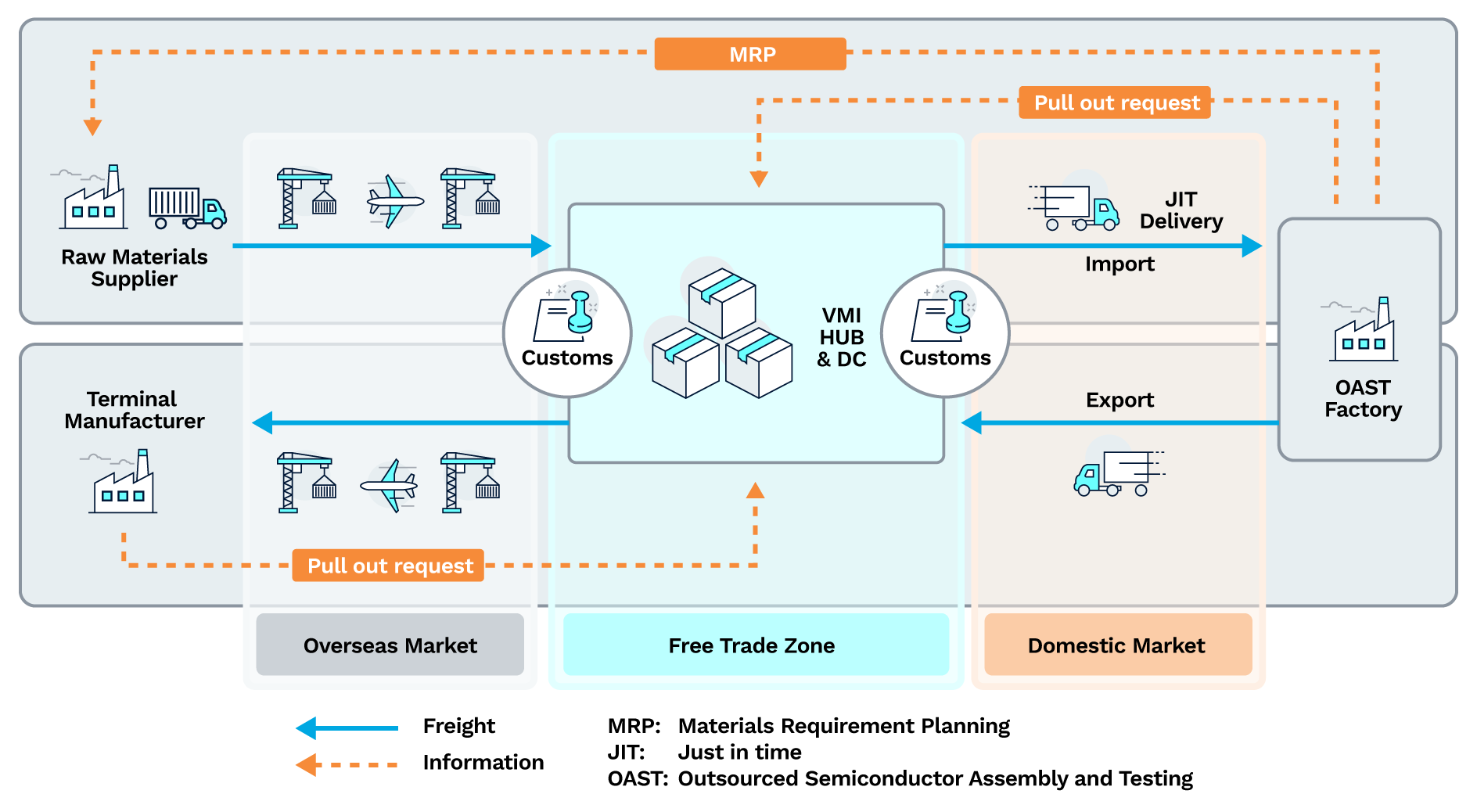
How the VMI + DC Model Works
VMI: Enabling Proactive Inventory Positioning
Suppliers place inventory close to key production sites based on forecasted demand. Inventory is kept within optimal range to support just-in-time manufacturing.
Benefits include:
- Reduced safety stock and capital lock-up
- Faster replenishment through local deployment
- Better responsiveness to demand shifts
DC: Establishing Regional Fulfillment Hubs
Bonded and non-bonded distribution centers act as the regional link between global suppliers and local factories.
Capabilities include:
- Semiconductor-grade warehousing with environmental controls
- Agile distribution to factories, distributors, and OEMs
- Value-added services including sorting, packaging, labeling, and inspection
Together, the VMI + DC model balances global coordination with regional agility.
What Makes Execution Successful
1.) Regulatory readiness: Navigating trade rules and export controls across China, Southeast Asia, India, and beyond requires on-the-ground compliance teams and certifications.
2.) Integrated transport and clearance: Combining air freight, cross-border trucking, and express with advanced customs programs such as AEO clearance and consolidated declarations streamlines flows.
3.) Digital visibility: Platforms like MyDimerco provide inventory tracking, AI forecasting, and full order lifecycle monitoring, helping synchronize information across stakeholders.
4.) Automated workflows: Custom SOPs embedded in Warehouse Management Systems (WMS) and supported by Robotic Process Automation (RPA) reduce human error and speed up execution.
Case Example: Beijing VMI + DC Hub
Since 2008, Dimerco has operated a bonded VMI warehouse in Beijing to support semiconductor testing and packaging in Northern China.
- Inbound: Overseas suppliers store materials in a bonded warehouse. Factories draw inventory per production order and pay based on usage, reducing safety stock and financial exposure.
- Outbound: Finished chips are stored and shipped via express or air freight based on regional orders.
- Flexibility: The site also supports customer-nominated carriers and full international delivery coordination.
This model has helped reduce on-site inventory, improve cash flow, and create a centralized hub for both inbound supply and outbound distribution.
Where the VMI and DC Model Is Deployed
Dimerco operates similar bonded and non-bonded facilities in Taipei, Hong Kong, Singapore, and San Francisco. These serve as VMI or DC nodes for finished goods consolidation, regional dispatch, and fulfillment. Facilities support a range of needs including temperature control, returns processing, and light assembly.
Examples:
- Taipei DC: Located in the Taoyuan bonded zone, it supports storage, packaging, and Asia-Pacific exports.
- Hong Kong DC: Leverages free trade policies to serve China, Southeast Asia, and global markets.
- Singapore DC: Based in the airport FTZ, it enables rapid order fulfillment and global coordination for multinationals.
Rethinking Semiconductor Supply Chain Strategy
As the semiconductor industry evolves toward regional manufacturing and faster innovation cycles, logistics strategies must keep pace. The VMI + DC model supports a more agile and capital-efficient approach.
Key factors for success:
- Position inventory closer to production
- Ensure visibility and coordination across the network
- Build flexibility into storage and transport
This model is not only a logistics tactic. It is a strategic approach to unlocking growth in high-value, high-complexity supply chains.
To explore how this model could apply to your operations, get in touch with a Dimerco specialist.
