
Low water, severe storms and congestion are putting pressure on global freight networks just as shippers face rising spot rates and an unpredictable peak season.
Water levels are falling at the Panama Canal and along parts of the Rhine, while storms across Asia have disrupted vessel schedules and port operations.
These events may be happening thousands of miles apart, but their impact can quickly spread across international supply chains.
The Freight Buyers’ Club host Mike King discussed the outlook with Nils Roche, founder of Solvens Advisory, and Mark Chadwick, president of the Global Shippers’ Association. Their conversation pointed to a freight market where weather, rates, capacity, reliability and tariffs are increasingly interconnected.
For small and mid-sized shippers in particular, that combination of freight disruption can quickly become both an operational and financial problem.
Low water adds pressure to already stretched networks
The Rhine shows how quickly a weather event can affect the wider freight network.
Low water levels restrict how much cargo barges can carry, which can push more freight onto road and rail networks. That adds pressure to inland capacity and can leave cargo sitting at ports for longer.
Conditions at the Panama Canal are creating similar concerns. Lower water levels can affect vessel drafts and the amount of cargo ships are able to move through the canal, potentially changing routing and capacity decisions.
Severe storms across Asia are disrupting schedules at some of the world’s busiest shipping hubs.
For shippers, the issue is how quickly disruption in one part of the network can spread. Delays can affect vessel rotations, container availability, inland transport and delivery schedules elsewhere.
Spot rates are creating a bigger divide
Freight disruption is also contributing to a difficult pricing environment.
King highlighted significant increases in spot rates from earlier in the year. While Asia-Europe rates had begun to soften, Asia-US rates were still rising.
Chadwick said the US peak season had lasted longer than expected, although he expects demand to weaken as inventories become better stocked.
Tariff uncertainty and instability in key trade routes have also encouraged some companies to bring shipments forward, changing the traditional timing of peak-season demand.
Why SMEs are more exposed
This matters because there is a growing difference between contract and spot pricing.
Large shippers with annual contracts can protect much of their volume from sudden market movements, but even they can be pushed onto the spot market when unexpected demand appears or shipments are moved forward.
For SMEs, the exposure can be much greater.
Smaller shippers often have less purchasing power, lower contracted volumes and fewer alternatives when capacity tightens.
If spot rates rise well above contract levels, even a relatively small amount of unplanned freight can have a significant effect on the logistics budget.
Reliability falls as blank sailings rise
Cost is only one side of the problem.
Xeneta data discussed during the podcast showed global on-time carrier performance falling for the second month in July, with average delays also increasing.
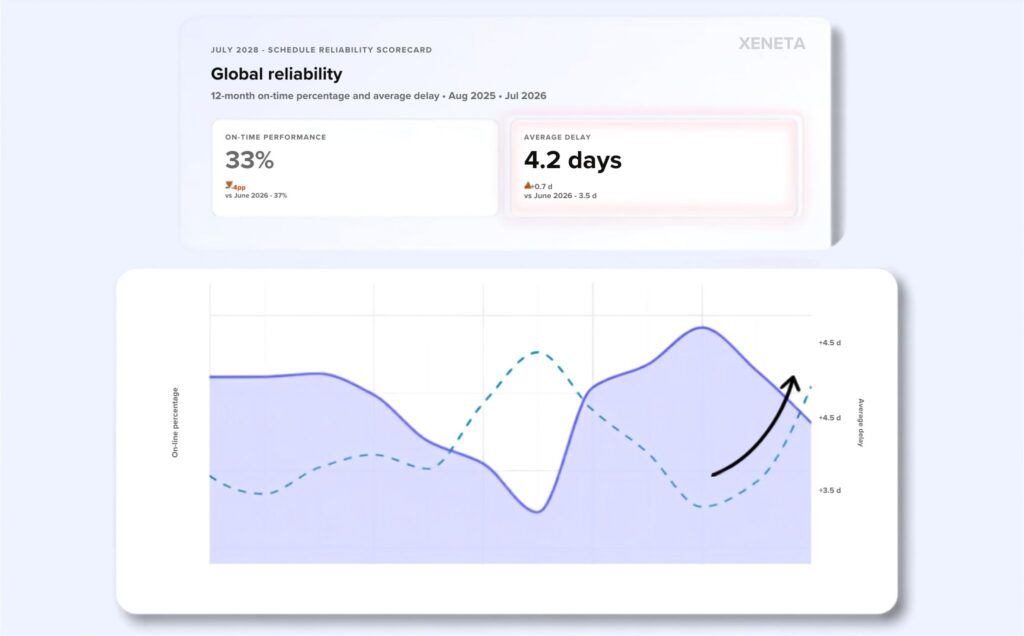 Port congestion is contributing to the decline. Major Asian hubs including Shanghai, Busan, Qingdao and Singapore have all faced pressure, while trucking and rail constraints are adding further complications once cargo reaches land.
Blank sailings are another important part of the reliability picture.
Carriers can withdraw sailings when they need to adjust capacity, but the increasing size of container vessels means a single cancelled sailing can remove a substantial amount of capacity from the market.
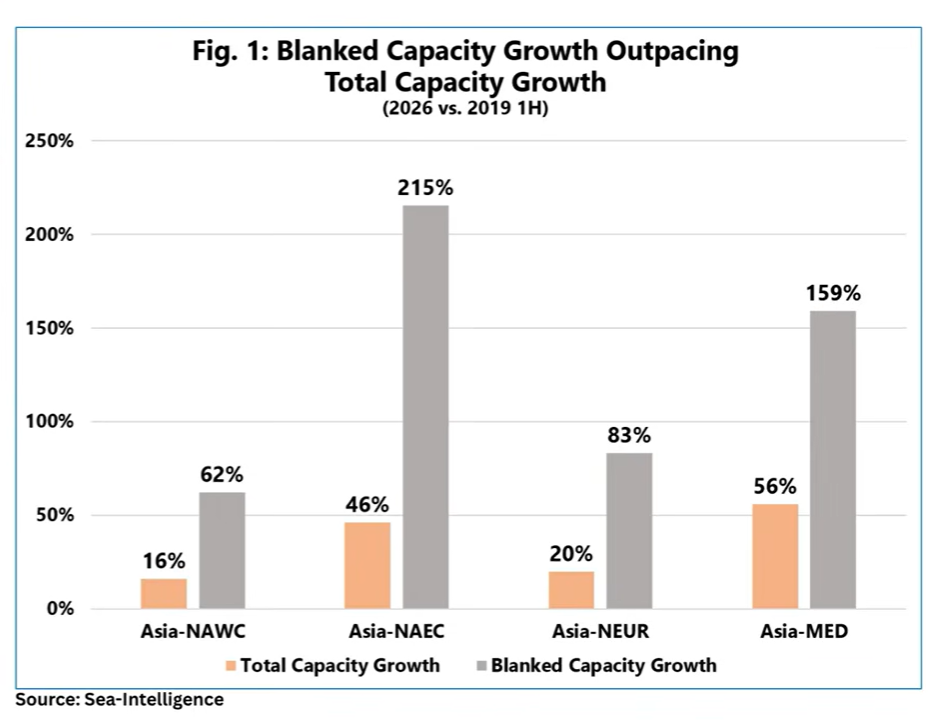
For a shipper, that can mean waiting for the next vessel and adding days or even another week to a shipment.
Chadwick also raised the importance of how reliability is measured. If a sailing is cancelled altogether, traditional on-time statistics may not fully reflect what the shipper experiences.
For cargo owners, the more useful question is straightforward: can the shipment arrive when the customer expects it?
Tariffs are creating a cash-flow challenge
Tariff uncertainty is adding another layer of pressure, particularly for SMEs.
The discussion highlighted cases where shippers were still waiting for tariff refunds to make their way back through brokers.
For a large multinational, that can create additional administration and temporarily tie up cash. For a smaller company, the effect can be far more serious.
Working capital that remains tied up in tariff payments cannot be used elsewhere in the business.
Companies also have to keep track of changing tariff requirements and understand what those changes mean for future imports.
Larger organizations may have dedicated teams handling customs and trade compliance. SMEs are more likely to depend on brokers, forwarders and logistics providers for support.
That makes access to knowledgeable partners increasingly important when trade rules are changing quickly.
Could higher freight rates become more permanent?
One of the strongest predictions in the discussion came from Roche, who said he does not believe container carriers will lose money over a full year again.
His argument is that the relationship between supply, demand and pricing has changed.
When demand increases on a trade lane, carriers can respond quickly with pricing changes and capacity management. Rates may later fall, but periods of strong pricing can help offset weaker parts of the year.
Blank sailings are part of that equation. Fewer major carriers operating larger vessels means capacity can be adjusted relatively quickly when market conditions change.
What this means for shippers
Chadwick focused more on how carriers and forwarders behave when disruptions occur. Shippers, he said, are likely to remember which partners worked constructively with them and which simply passed on every possible additional cost.
That distinction could become increasingly important when contracts are renegotiated.
If higher underlying rates and continued volatility become a longer-term feature of the market, SMEs are likely to remain particularly exposed.
They have less negotiating leverage and fewer options when they face higher spot rates, additional surcharges, shipping delays and tariff-related cash-flow pressure.
What could drive the next wave of disruption
Looking toward the rest of 2026 and into 2027, Roche identified several areas to watch, including possible changes to marine fuel costs, further severe weather and the different strategies carriers adopt as they compete for customers.
Chadwick is watching carrier partnerships closely, along with conditions in the Strait of Hormuz and Red Sea.
Low water in Europe is another issue that may continue to affect inland freight long after the immediate weather event has passed.
Together, these risks point to a market where disruption in one area can quickly create pressure somewhere else.
A storm can disrupt vessel schedules. A delayed sailing can push cargo onto the spot market. Low river levels can shift freight onto constrained trucking networks. Tariff uncertainty can encourage companies to ship earlier, adding demand at a time when capacity is already tight.
Build more flexibility into freight planning
For shippers, the priority is to build enough flexibility into freight planning to respond when conditions change.
That can mean considering alternative routings, balancing ocean and air freight, booking capacity earlier where possible and improving visibility across the supply chain.
Dimerco supports customers across ocean freight, air freight, customs and multimodal transport, helping them find alternative options when routes, capacity or trade requirements change.
For more freight market updates and future episodes, subscribe to the Freight Buyers’ Club podcast.
If changing freight conditions are affecting your supply chain plans, get in touch with a Dimerco Specialist to discuss the options available.
