
Global port congestion is not easing, and container shipping reliability keeps failing to recover to pre-pandemic levels.
Nearly a quarter of a vessel’s time at port is now spent simply waiting for a berth, more than five percentage points above 2019 levels, and that figure has remained elevated since 2021.
In the latest episode of The Freight Buyers’ Club podcast, host Mike King speaks with Eleanor Hadland, Senior Analyst, Ports and Terminals at Drewry Maritime Research and Director of Hadland Maritime, about what is keeping ports congested and where pressure is likely to persist.
They also tackle a more contentious question. Maersk CEO Vincent Clerc has pointed to a lack of port investment as a cause of today’s congestion. Yet ocean carriers themselves now control around 45% of global container terminal capacity.
So, is port investment really the problem?
Ships are spending more time waiting for a berth
Hadland said Drewry tracks 225 major ports every month using AIS data, with the number of port calls growing far more slowly than throughput.
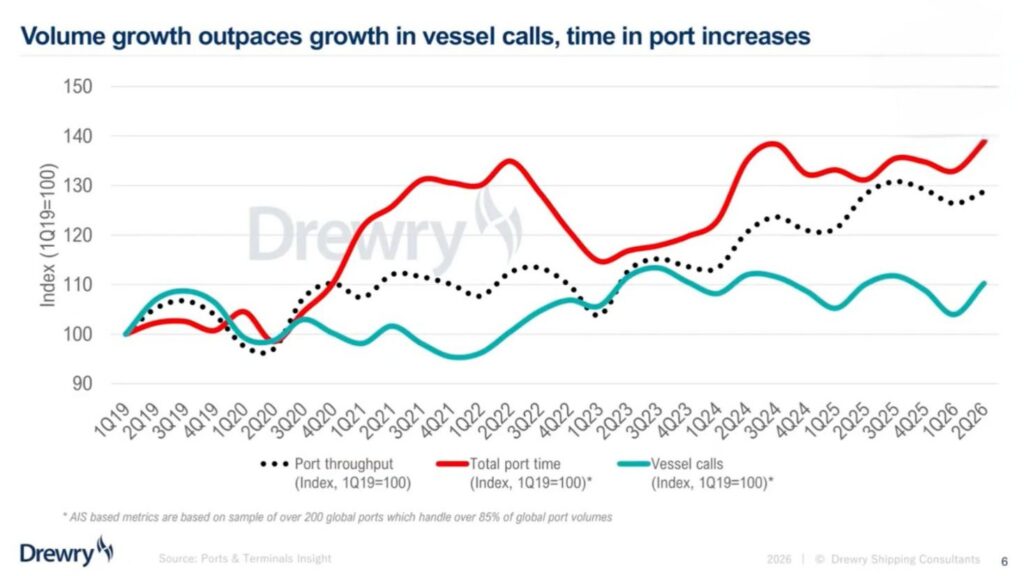
Vessel sizes are part of the reason. As ships have grown larger, ports have had to accommodate more cargo during each call, while the time vessels spend in port has also increased.
A significant share of that time is spent waiting.
In 2019, around 17% of the total time container vessels spent at Drewry’s sample ports was classified as pre-berth waiting. That climbed to 24% at the beginning of 2021 and eventually peaked at 27%.
By the second quarter of 2026, it had risen back to around 25%.
Hadland says ports cannot take all the responsibility for these delays. Bigger ships put more pressure on terminals when they arrive, while unreliable vessel schedules make it harder for ports to plan capacity. Problems with inland transport can also keep containers sitting in terminals for longer.
Congestion may be most visible at the port, but the cause does not always begin there.
Shanghai and Ningbo have little room for disruption
Some of the greatest pressure is being felt at Asia’s largest container hubs.
Chinese terminals have become highly efficient, but they are also operating with much less spare capacity.
Hadland said stack utilisation at modern terminals can run at around 85% as the norm. Earlier port planning guidance put non-peak utilisation closer to 65%.
This leaves little room to absorb disruption when a storm hits or vessel schedules slip.
“When you’ve got the intensity of coverage you’ve got at Shanghai and Ningbo, it’s not surprising terminals quickly become overwhelmed,” Hadland said.
New capacity is coming. A new terminal at Yangshan is expected to provide some relief, while Ningbo has additional terminals under development.
Those projects will take time, however, and Hadland expects congestion at Shanghai and Ningbo to continue.
Southeast Asia is also investing as global export trade shifts into the region. Port Klang is expanding, new capacity is coming online at Tuas in Singapore, and PSA’s Pasir Panjang terminal is also being expanded.
Europe faces pressure at the port and inland
Rotterdam and Antwerp are dealing with their own capacity constraints.
Low water levels on European waterways have reduced the amount of freight that can move by river, putting more pressure on road and rail.
Labor shortages and strikes have added further problems. Some terminal upgrades are also temporarily taking capacity out of service while the work is completed.
There should be some relief as new capacity comes online at Rotterdam World Gateway and APM Terminals. Antwerp should also benefit from the upgrade of Antwerp Gateway.
But the problem extends beyond the terminals.
Once congestion develops at Rotterdam or Antwerp, delays can carry through to German ports and across inland transport networks. Hadland expects problems on European waterways to remain an issue for some time.
Low water is affecting Panama Canal routing
Falling levels have led to draught restrictions and higher costs. For freight buyers, that adds another consideration when deciding whether cargo should enter the US through the West Coast or continue towards East Coast ports.
Hadland does not expect a major swing back towards the West Coast.
More US imports are already shifting from China to Southeast Asia, where routing via Suez or the Cape can favour the East Coast. Ports such as Savannah have also invested in infrastructure and transport connections that help keep cargo moving through the East Coast.
Mike also noted that some Canadian shippers are directing more cargo through Canadian ports where that suits their supply chains, while USMCA negotiations continue to drag on.
The cost of moving containers inland by rail from the West Coast is another reason Hadland does not expect a major reversal.
Can ports take all the blame?
Maersk CEO Vincent Clerc has argued that a lack of port investment over the past 15 years has contributed to the congestion shippers are experiencing.Hadland questions whether the numbers support that argument.
Between 2010 and 2025, she said the container port industry added well over half a billion TEU of capacity, while container volumes grew by around 480 million TEU.
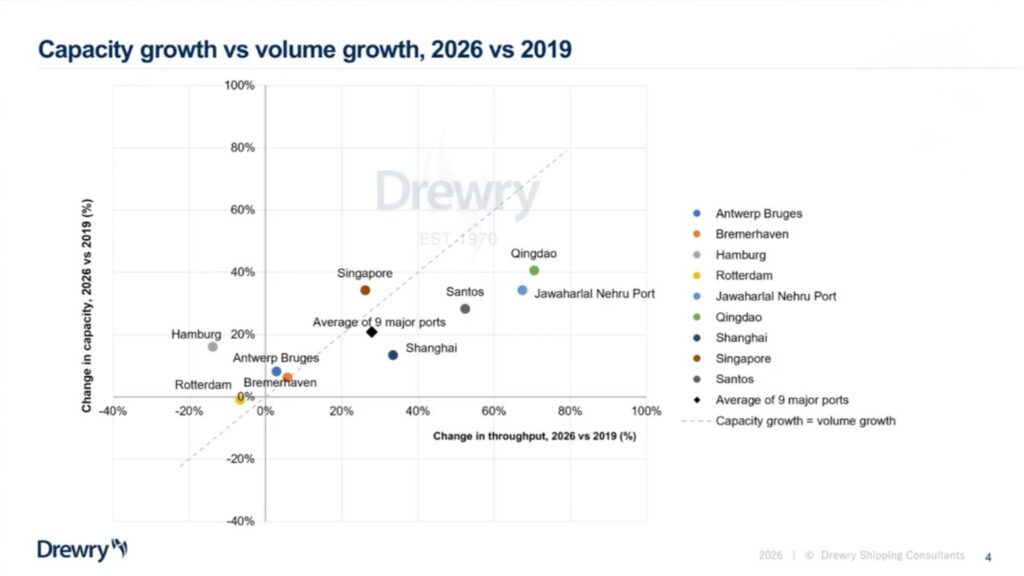
Capacity has not grown evenly
Ports have also had to invest just to handle the same traffic as vessels have grown larger. That includes deeper channels and berths, along with bigger cranes capable of handling ultra-large container ships.
The question, according to Hadland, is whether enough capacity has been built in the right places. In some emerging markets, volume growth has outpaced capacity growth. In more mature markets such as the US and Europe, the reverse has been true.
There is another part to the debate. Ocean carriers now control around 45% of global container terminal capacity, and Hadland expects their investment in terminals to continue, particularly at major ports where securing access to capacity is important.
She also argues that congestion should not be treated as a standalone port problem.
Larger vessels and unreliable schedules affect terminal performance, while constraints on inland transport can prevent cargo from leaving terminals efficiently.
Ports sit in the middle of these problems without controlling everything around them.
Having a plan B matters
For freight buyers, Hadland’s message is that disruption is now the norm.
Some improvement should come as new terminal capacity opens in Northern Europe. The outlook for China is more difficult.
New capacity is under development, but Shanghai and Ningbo continue to handle huge volumes with limited room to absorb disruption.
Having a plan B is becoming more important as a result.
For shippers, that means knowing what alternatives are available when the original plan no longer works. Better supply chain visibility can also provide more time to respond when congestion, weather or geopolitical events affect a route.
Dimerco can help shippers build more resilience into their supply chains and provide the visibility needed to respond when conditions change.
Connect with a Dimerco specialist to discuss your shipping needs and prepare for potential disruption.
And for more conversations on the issues affecting global freight, subscribe to The Freight Buyers’ Club.
