
US trucking costs are climbing sharply, although freight demand has remained relatively flat. Truckload spot rates have risen by around a third year over year, driven largely by a shrinking pool of available trucks rather than a surge in freight volumes.
For businesses shipping goods into the US, this creates another cost challenge. Securing ocean or air freight capacity is only part of the equation, as moving cargo from the port or airport to its final destination can be increasingly expensive.
In this episode of The Freight Buyers’ Club, Dean Croke, Principal Analyst at DAT iQ, and Bill Cassidy, Senior Editor, Trucking at the Journal of Commerce, discuss what’s driving the increase and what shippers should expect heading into 2027.
Why Is US Trucking Capacity Shrinking?
The US trucking industry is losing capacity as trucks and drivers leave the market.
Croke points to the industry’s rapid expansion during the pandemic as a contributing factor:
“We had this massive exodus of capacity from the industry, which I think was the hangover from the doubling of capacity during the pandemic.”
Tighter enforcement of driver licensing, immigration status and English-language proficiency requirements has added pressure, alongside increased checks at truck stops.
Diesel costs are also influencing carrier decisions. Croke noted that California diesel reached $8.24 per gallon at the time of recording, nearly $3 more than in Georgia.
Higher fuel costs are making carriers more selective about routes, particularly those involving empty return journeys. As Cassidy explains:
“It’s not simply a matter of supply going up and down, expanding or contracting. I think it’s also dislocation of supply.”
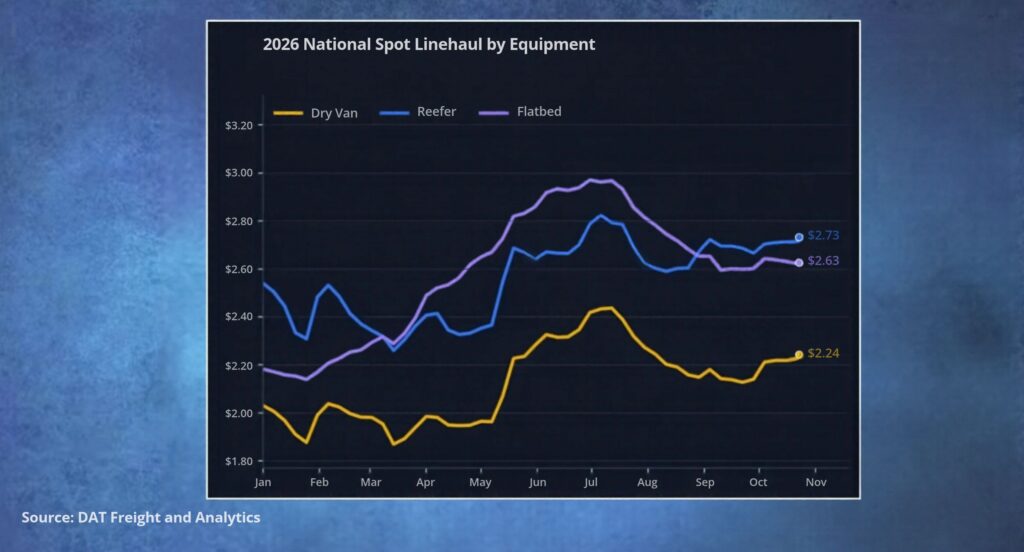
Why National Trucking Rates Don’t Tell the Full Story
Inland transportation costs depend heavily on the route. Croke noted that imports into Los Angeles were approximately 19% higher year over year at the time of recording.
While the national average dry van spot rate was around $2.22 per mile, excluding fuel, Croke cited $4.42 per mile on the Los Angeles–Phoenix corridor.
For importers, national averages can significantly understate the cost of moving goods inland.
Why Port Drayage Costs Are Also Rising
Port drayage is facing similar pressures. Data from the Drayrates–Journal of Commerce National Drayage Price Index presented during the podcast showed rates increasing across US coastal regions, with particularly sharp rises at Gulf Coast ports.
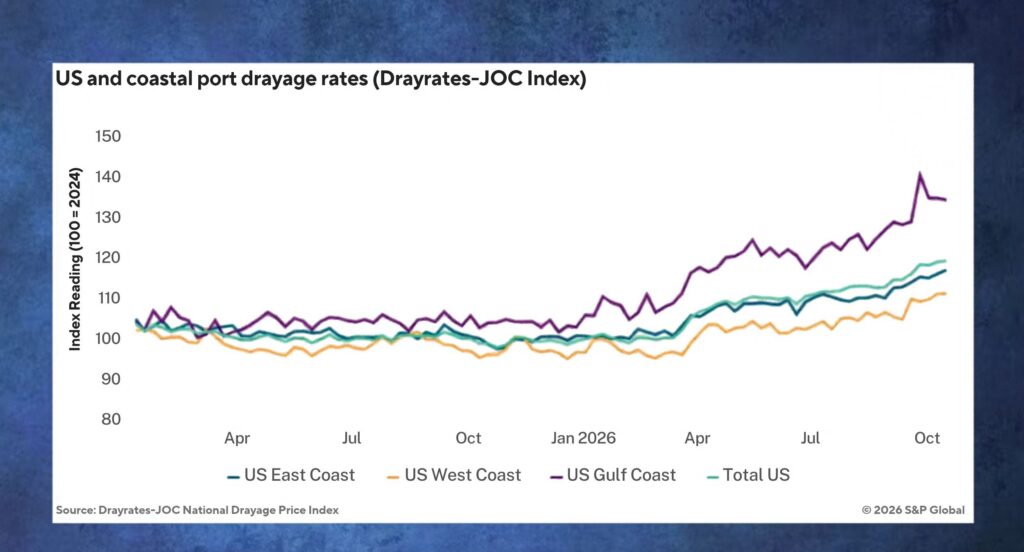
Cassidy explained that trucking capacity in Texas is being drawn toward higher-paying work in resin exports, oil and infrastructure projects, including data center construction. This leaves fewer trucks available for port drayage, pushing rates higher.
Diesel Prices and the US Midterm Elections
Unlike the trucker protests seen in 2022, rising diesel prices have drawn a quieter response in 2026. Croke explained that higher spot rates and fuel surcharges have helped some carriers absorb fuel costs, while others continue to struggle.
With the US midterm elections on November 3, trucking regulations and trade policies remain important issues for shippers to watch.
Planning Your US Inland Transportation
Dimerco’s Perspective
Our November 2026 Asia Pacific Freight Report highlights continued freight activity at major US gateways, including Los Angeles/Long Beach, New York/New Jersey and Savannah, supported by holiday retail demand.
International freight capacity also remains tight. As Kathy Liu, VP, Global Sales and Marketing at Dimerco Express Group, noted: “The US rally has peaked, but space isn’t opening up. With no freighter capacity coming before year-end, rates will settle high rather than drop.”
While Liu’s comments concern air freight, rising US inland costs also make early transportation planning important. Shippers should review lane-specific trucking rates, allow flexibility in delivery schedules and consider intermodal alternatives where practical.
What Should Shippers Expect in 2027?
Croke expects driver availability to remain a major challenge for the US trucking market in 2027.
Cassidy shares this concern, noting that stronger freight demand could push transportation costs significantly higher if trucking capacity remains constrained. He also discussed the difficulty of expanding driver supply, suggesting that the issue may persist beyond the current market cycle.
Intermodal Rail Offers an Alternative to Trucking
One alternative gaining traction is intermodal transportation. According to figures from the Journal of Commerce’s Intermodal Savings Index cited by Croke, intermodal rail offered approximately 34% savings compared with spot trucking and 30% compared with contract trucking.
For businesses shipping into the US, inland transportation deserves as much attention as the international leg of the journey. Dimerco helps coordinate international freight and inland transportation across Asia and North America, supporting cost control and delivery planning.
Subscribe to The Freight Buyers’ Club for regular discussions on freight markets, shipping trends and the issues affecting global supply chains.
