AI has become one of the biggest new drivers of freight demand, but the market may soon feel it in two different ways.
One is the build-out of data centers: concrete, steel, power systems, generators, transformers and cooling equipment needed to get facilities running. That demand is feeding project cargo, container shipping and U.S. domestic trucking.
The other is what goes inside those buildings: servers, chips, memory, cabling and processors. Much of that cargo moves by air.
Dimerco has already seen that pressure up close in Taiwan, where AI server and chip exports have tightened air cargo capacity. In an earlier Freight Buyers’ Club conversation, Dimerco CEO Jeffrey Shih discussed how security, capacity planning and flexible routing are becoming more important as high-value AI cargo moves out of Taiwan.
According to Chris Rogers, Head of Supply Chain Research at S&P Global Energy, this second wave may last much longer.
Building slows, equipment keeps moving
Speaking on the latest episode of The Freight Buyers’ Club, Rogers said data center buildings may last 20 to 25 years. The equipment inside them does not.
Chips and related hardware need to be refreshed every five, six or seven years, he said. That makes AI a continuing source of freight demand, not just a construction boom.
Rogers expects pressure from the physical build-out to ease over time, with project, container and trucking demand potentially slackening after 2030.
For air cargo, however, AI-related pressure could continue to shape the market for the next five to ten years.
Building the shell versus filling the racks
Rogers broke AI freight demand into two parts: “the infrastructure, the shell, the data center itself, and then the contents.”
Data centers, he said, “just look like warehouses,” but require major electrical infrastructure around them. Build-out freight includes steel, aluminum, concrete, cooling systems, transformers, generators and other power-related equipment.
Inside, the cargo changes. Data centers are filled with servers and specialist electronics, including graphics processors, central processors, high-bandwidth memory, interconnects and optical transceivers.
Rogers described these as “highly complicated, bespoke” electronics. Asia plays a central role, with Taiwan important for chips, South Korea for memory, and China, Vietnam and Mexico involved in server assembly.
Containers, projects and delays
On the ocean side, Rogers said AI-related IT equipment is still small in container terms. He put US imports of information technology products at around 35,000 TEUs a month, compared with total US imports of about 2.7 million TEUs.
The bigger container impact is on capital equipment. Rogers said building products were around 107,000 TEUs and up 19% year on year in October, while power generating equipment reached 69,000 TEUs, up 33%.
Local pushback could also shift the timing. Rogers said bans and pauses in parts of the US, along with opposition in other markets, are likely to push some projects down the road.
“What it’ll effectively do is just push the build down the road,” he said. In his view, around 10% to 15% of the US build planned for 2027 could move into 2028. Because large infrastructure projects are booked ahead, some cancelled freight bookings could appear in late 2027.
Investment and capacity pressure
Investment in AI is still running at a high level. Mike King put the scale into context: hyperscaler capital expenditure has more than tripled in two years, from around $245 billion in 2024 to about $775 billion this year, with forecasts pointing to $1.15 trillion by 2028.
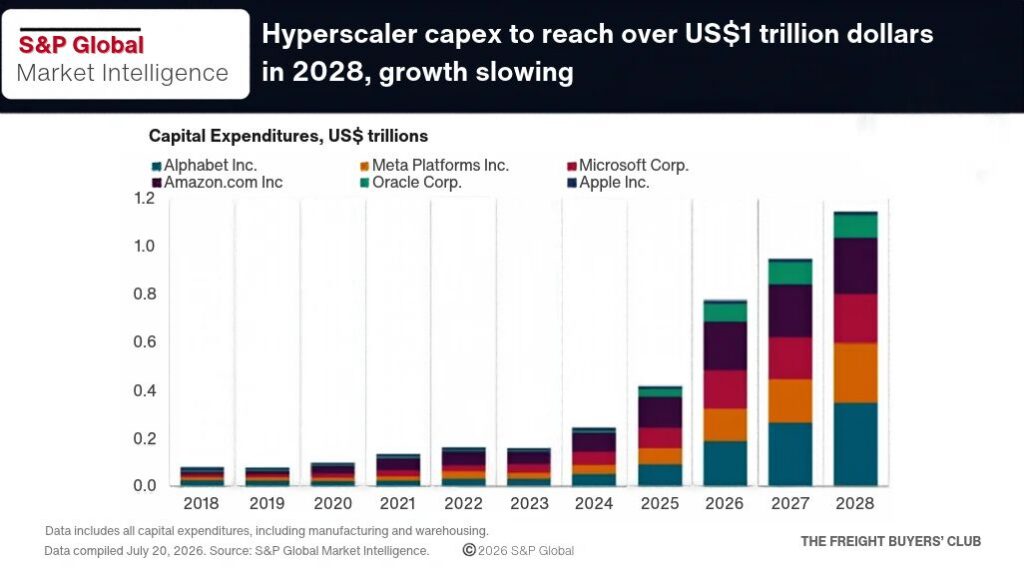
Rogers compared the scale of AI investment with railways and electrification, although he said AI is moving much faster. “It has been transformative to capital markets,” he said. In his view, investment is likely to continue, but at a slower rate.
AI companies are not the only ones feeling the strain. Rogers said AI demand is crowding out other shippers and raising costs for industries that rely on the same inputs, from steel, copper and transformers to memory chips, circuit boards and game consoles.
“You can’t create a whole new industry of demand without creating a load of demand for freight services,” he said.
Taiwan–U.S. air cargo comes under pressure
Air cargo is where the pressure is most visible. In a previous podcast episode, Jeffrey Shih pointed to rising Taiwan–U.S. AI cargo volumes, with air export tonnage from Taiwan roughly doubling over the past two years and cargo charter flights to the U.S. climbing month by month.
Mike King pointed to IATA figures showing AI-related goods account for more than half the value of air-transported trade, but only around 7% of volume. He also cited Aevean data showing U.S. data center-related air imports reached 107,000 tons in September alone.
For Rogers, the reason is straightforward: “You don’t really want those floating around at sea for six weeks in a saltwater environment,” he said. “Those need to be shipped by air.”
Build flexibility as AI freight demand shifts
Rogers pointed to a practical lesson for buyers: the companies coping best are those with diversified supply or those that booked ahead.
As AI reshapes freight demand, early booking and flexible routing will matter. Get in touch with a Dimerco specialist to discuss upcoming freight needs.
For the full conversation, listen to the latest episode of The Freight Buyers’ Club and subscribe to the podcast.