Quick Summary >
What U.S. Importers Should Know
- Trade fraud enforcement is becoming more coordinated across federal agencies.
- Importers remain responsible for the accuracy of customs information, even when using a customs broker.
- Enforcement risk can extend beyond duties to civil, criminal, forced labor and supply chain issues.
- Importers should strengthen due diligence, documentation and processes for identifying and correcting compliance issues.
The future of customs compliance is not simply about getting the entry right. It is about being able to prove that you got it right and that you took reasonable steps to identify and correct problems when something went wrong.
In July 2026, the Department of Justice (DOJ) and Department of Homeland Security (DHS), working through the Trade Fraud Task Force, released A Resource Guide to Trade Fraud Enforcement. The government describes the guide as the first comprehensive framework of its kind for cross-border trade compliance and enforcement.
The guide is designed to help businesses understand both their customs obligations and the government’s enforcement tools.
More importantly for importers, it provides a look into how DOJ, DHS, CBP and other federal agencies are increasingly approaching customs violations.
Trade compliance is no longer just about paying the correct amount of duty.
It is increasingly viewed by government enforcement agencies as an issue of fraud prevention, revenue protection, national security, forced labor prevention, public safety and corporate accountability.
Why This Guide Matters for Importers
The guide signals a shift from traditional CBP administrative enforcement toward more coordinated civil and criminal enforcement.
The Trade Fraud Task Force, launched in August 2025 and now supported by almost 500 attorneys, reported more than $1 billion in civil and criminal recoveries, penalties, forfeitures and publicly charged losses in less than one year. CBP also reported more than $2.1 billion in commercial trade penalties during the fiscal year.
A Much Broader View of Trade Fraud
The Resource Guide covers the basic customs entry process, the responsibilities of Importers of Record and customs brokers, post-entry activities and a wide range of trade enforcement authorities.
| Compliance Area | Examples of Fraud and Compliance Violations |
|---|---|
| Customs declarations | False or inaccurate customs entries, undervaluation, incorrect tariff classification |
| Origin and routing | False country-of-origin declarations, illegal transshipment |
| Duties and trade remedies | Evasion of antidumping and countervailing duties, Section 301 and other trade remedy tariff evasion, drawback fraud |
| Trade documentation and parties | Free trade agreement fraud, manifest fraud, shell companies, customs broker fraud |
| Responsible sourcing and product compliance | Forced labor, product safety violations, forged safety or environmental certifications |
Focusing solely on classification, valuation and duty payment is no longer enough. The government is taking a much broader view of compliance.
During CBP’s annual trade summit in September, one official told attendees that importing is no longer regarded by the government as a right, but as a privilege.
Importers were urged to come into compliance, perform appropriate due diligence and understand the many trade laws and regulations governing imports into the United States.
The Importer of Record Remains Front and Center
The guide begins with the customs entry process, emphasizing the responsibilities associated with importing merchandise into the United States.
These include the information provided to CBP, the accuracy of the entry, supporting documentation and subsequent post-entry activity.
The guide reinforces a fundamental principle of U.S. customs compliance: the Importer of Record is ultimately responsible for exercising reasonable care and providing accurate information to CBP.
Importer Responsibility
Using a licensed customs broker does not transfer that responsibility to the broker.
What Importers Still Need to Control
A broker can prepare and transmit an entry, but the importer needs appropriate internal controls to make sure the information supplied to the broker is accurate and complete.
CBP is also emphasizing the need for importers to perform due diligence on suppliers and on information received from third parties.
Importers must understand the customs laws and regulations that apply to their transactions and take appropriate steps to comply.
Willful blindness to relevant facts or requirements may not provide a defense if the government launches an audit or investigation.
This distinction becomes especially important as enforcement becomes more aggressive.
The False Claims Act Is a Major Concern
Perhaps one of the most significant aspects of the new Resource Guide is its discussion of the False Claims Act (FCA).
Historically, many customs violations were viewed primarily through the lens of administrative enforcement, including additional duties, liquidated damages, penalties under Section 1592 and other CBP remedies.
The government’s current approach demonstrates that certain conduct can also result in civil litigation under the FCA, potentially creating substantially greater financial exposure and, in some cases, criminal proceedings.
The FCA can provide for treble damages and civil penalties. It also contains a whistleblower mechanism that allows private parties to bring certain actions on behalf of the government and potentially receive a share of the recovery.
This creates an additional enforcement risk for companies.
An employee, supplier, competitor or other party with information about alleged trade fraud may have a financial incentive to bring the matter to the government’s attention.
For importers, this means customs compliance increasingly deserves attention beyond the trade or logistics function. Companies should make sure appropriate management teams understand the potential financial and operational risks associated with noncompliance.
Criminal Enforcement and Downstream Supply Chain Risk
The Resource Guide describes numerous criminal statutes that can apply to trade-related misconduct, including false customs statements, smuggling, fraud, money laundering and other violations.
These statutes can also extend beyond the traditional Importer of Record. Under certain circumstances, other parties that knowingly receive or sell illegally imported merchandise can become part of an enforcement action.
Trade compliance risk can therefore extend further down the supply chain, even when a company is not the Importer of Record in a transaction.
This can be particularly relevant for ultimate consignees and companies purchasing goods under Delivered Duty Paid (DDP) terms. Ignoring warning signs associated with an import transaction may not protect a company from enforcement simply because another party handled the importation.
Companies should understand who is importing their goods, how the goods are being entered and whether transaction details raise compliance concerns.
Forced Labor Remains a Major Enforcement Priority
Forced labor is another priority trade issue in the government’s enforcement strategy.
The guide discusses CBP’s authority under Section 307 of the Tariff Act, Withhold Release Orders and Findings, the Uyghur Forced Labor Prevention Act (UFLPA) and the UFLPA Entity List.
These authorities increase the importance of supply chain visibility and due diligence. Importers may need to trace their supply chains and maintain sufficient documentation to demonstrate that imported goods are not connected to forced labor.
The expansion of the UFLPA Entity List into sectors including aluminum, PVC, seafood, steel, copper, lithium, electronics and other products further demonstrates the government’s continued focus on forced labor enforcement.
At CBP’s recent trade summit, senior officials also emphasized the risks associated with failing to understand second-, third- and fourth-tier suppliers. Importers that do not look beyond their direct suppliers may have significant gaps in their supply chain due diligence.
CBP also plans to make greater use of technology, including artificial intelligence, to identify forced labor indicators further down the supply chain.
What Importers Should Be Reviewing
Companies should therefore understand how they evaluate:
- Suppliers
- Manufacturers
- Raw material inputs at the second, third and fourth tiers
- Production locations and ownership
- Country-of-origin qualification
- Supply chain intermediaries
- Traceability documentation
Simply obtaining a supplier certification may not be sufficient if other information raises a red flag.
Remember, you never want CBP to know more about your supply chain than you do.
A forced labor detention can have serious downstream effects on inventory levels, production schedules and customer commitments.
You want to know about forced labor signals in your supply chain before a product is ordered and before they cause a ripple effect across your business.
The Three Themes Drive the Government’s Enforcement Strategy
The Resource Guide essentially organizes trade enforcement around three broad government interests:
-
- U.S. Fiscal and National Security
The government wants to ensure that companies pay the duties and other revenues legally owed to the United States and that trade remedies designed to protect U.S. national security are enforced. This includes enforcement against undervaluation, misclassification, misrepresentation of the country of origin, tariff evasion, AD/CVD evasion and other schemes designed to reduce customs liability or evade U.S. trade laws. - Public Safety
The government is also focused on products that may create health or safety risks, including merchandise subject to product safety, environmental or other regulatory requirements. False certifications or incomplete declarations can create consequences beyond just customs duties. - Forced Labor
Forced labor remains another major enforcement priority. Government agencies continue to allocate resources and technology to identify and prevent forced labor throughout international supply chains.
- U.S. Fiscal and National Security
What Does This Mean for Customs Compliance Programs?
The Resource Guide should prompt importers to take a fresh look at their customs compliance programs.
A strong program should not simply ask:
“Are we paying the right amount of duty?”
It should also ask:
“Can we demonstrate that the information we provide to the government is accurate, complete and supported by appropriate documentation?”
That requires appropriate controls across the traditional areas of customs compliance, including:
- Classification
- Valuation
- Country of origin and marking
- Recordkeeping
- Free trade agreement claims
- Trade remedies including antidumping and countervailing duty
- Forced labor and supply chain tracing
- Partner Government Agency (e.g. FDA or CPSC) compliance and product safety
- Supply chain security including CTPAT
Companies that have not recently performed a gap analysis in these areas should consider reviewing where their greatest compliance risks may exist.
Written policies and documented procedures can also help demonstrate how a company manages its customs responsibilities and addresses identified risks.
Where internal resources or expertise are limited, outside support can help assess gaps, strengthen controls and address priority compliance issues.
Red Flags Deserve More Attention
One of the key lessons from the government’s enforcement approach is the importance of identifying and responding to red flags.
An importer may not have intentionally participated in fraud. But if the company encounters information suggesting something may be wrong and fails to investigate or address it, the government may view the conduct differently. Potential red flags can include:
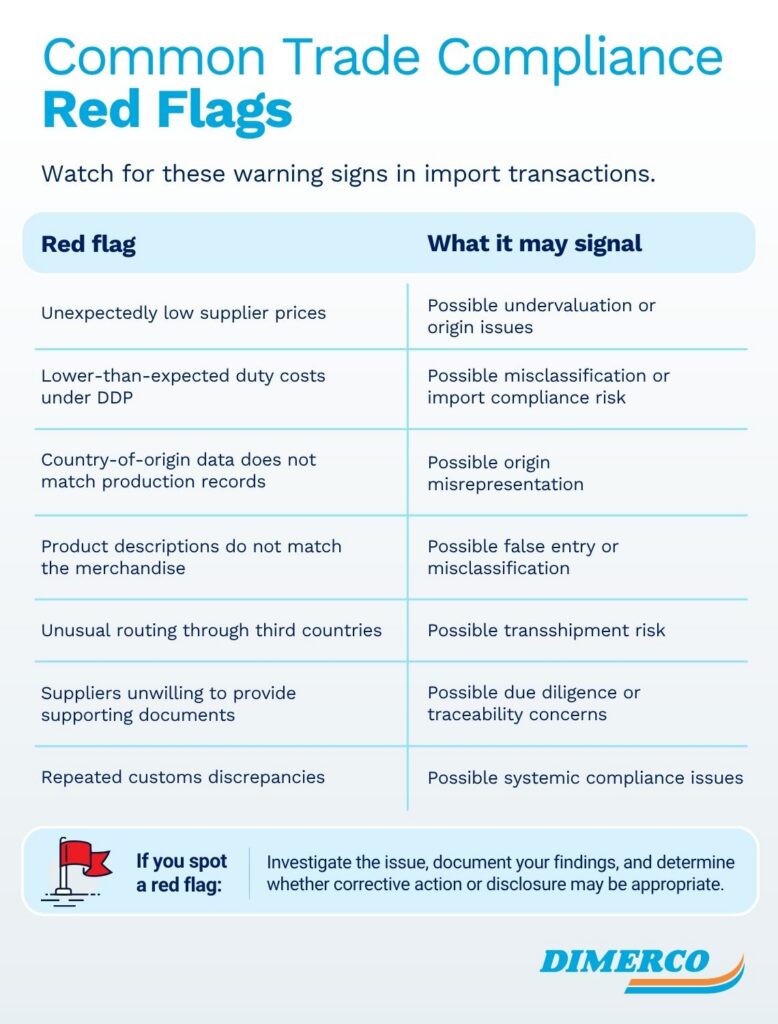
The answer to a red flag should not simply be to file the entry and hope for the best.
It should trigger an investigation and a documented compliance response. CBP reiterated at its recent trade summit that it expects importers to report any discrepancies it finds quickly.
A discrepancy found and reported quickly, through a voluntary disclosure or other acceptable means, before CBP, DHS or the DOJ make the discovery, will mitigate the consequences.
Documentation Is Becoming More Important
A key takeaway from the new guide is the importance of being able to demonstrate what the company knew, when it knew it and what it did in response.
That means maintaining appropriate documentation for areas such as:
- Policies and procedures
- Supplier due diligence
- Classification decisions
- Valuation methodologies
- Country-of-origin determinations
- Free trade agreement determinations
- Component tracing and forced labor reviews
- Antidumping and countervailing duty research
- Product safety reviews
- Broker instructions
- Customs entry packages
- Internal compliance reviews and audits
- Corrections and post-entry actions
A company that discovers a problem and promptly investigates, corrects and remediates it is in a very different position from a company that repeatedly ignores the same issue.
Good documentation helps demonstrate the steps taken and supports compliance with CBP record keeping requirements.
What Should Importers Do Now?
The new Resource Guide gives companies good reason to conduct a customs compliance health check. At a minimum, importers should consider the following steps.
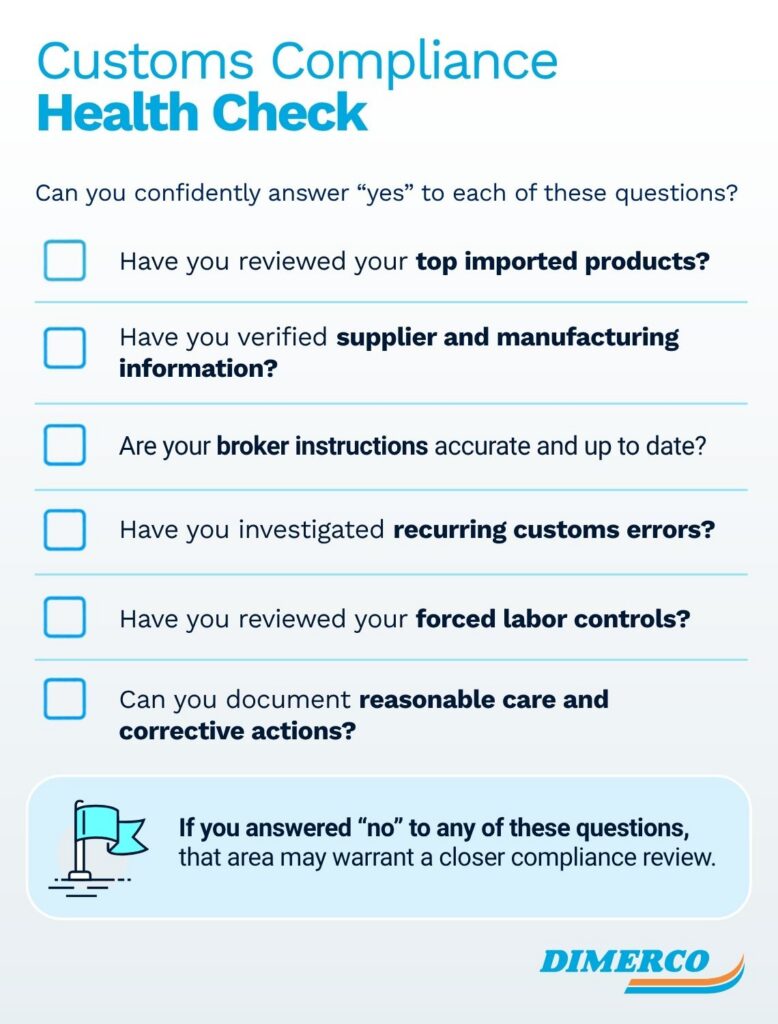
Priority Actions for Importers
- Review Your Top Imported Products
Confirm classification, valuation, origin, free trade agreement qualification, Partner Government Agency requirements and applicable trade remedies for key imported products. For higher-risk or more complex products, consider whether additional review is warranted. External expertise may also help identify compliant opportunities to manage duty costs. - Review Your Suppliers
Make sure supplier information is current, manufacturing locations and supply chains are verified, and relevant foreign suppliers and manufacturers have been appropriately vetted - Look for Recurring Errors
Multiple corrections involving the same issue may indicate a systemic control problem. Review the underlying cause, update internal controls where necessary and consider regular audits for higher-risk areas. - Review Broker Instructions
Confirm that customs brokers are receiving accurate product descriptions, HTS classifications, values, countries of origin and other compliance-related information. Remember that using a broker does not remove the Importer of Record’s responsibility for the accuracy of the entry. - Document Reasonable Care
Do not simply make the right decision. Maintain documentation showing how and why the decision was made. - Investigate Red Flags
Establish a process for escalating unusual transactions, discrepancies or inconsistent supplier information.Document the investigation, findings, subsequent audits and any corrective action taken. - Review Forced Labor Controls
Use supply chain tracing appropriate to your risk profile to evaluate forced labor exposure based on your actual supply chain. A supplier affidavit alone may not provide sufficient assurance where other information raises concerns. Companies can begin by tracing higher-risk components and verifying the information supplied by vendors. Where supply chains are complex, a combination of internal controls, supplier engagement, data analysis and specialized external support can help strengthen traceability. - Establish a Corrective Action Process
When an error is discovered, determine whether additional entries may be affected and whether a prior disclosure or other corrective action may be appropriate. Use findings to update policies, improve controls and adjust audit activity based on the company’s risk profile.
The Bottom Line
The new Trade Fraud Resource Guide should be viewed as more than an educational publication. It provides important insight into the government’s trade enforcement priorities and the tools available to federal agencies.
The guide demonstrates that customs enforcement is increasingly coordinated across CBP, DHS, DOJ, HSI and other federal agencies. It also shows how a customs violation can potentially result in consequences extending well beyond an additional duty bill.
For importers, the lesson is clear: do not wait for CBP, DOJ or another party to identify a compliance problem that could have been identified internally.
Companies with strong classification, valuation, origin, trade remedy, forced labor and recordkeeping controls, supported by appropriate documentation, will be better positioned to respond to this evolving enforcement environment.
The future of customs compliance is not simply about getting the entry right. It is about being able to prove that you got it right and that you took reasonable steps to identify and correct problems when something went wrong.
Ready to Strengthen Your Compliance Program?
Dimerco’s trade compliance team can help you assess compliance gaps, review high-risk areas and strengthen customs controls. Get in touch with a Dimerco specialist to discuss your trade compliance needs.