For smaller companies, ocean shipping expenses can eat up a good chunk of total revenue, so it pays to be a smart buyer of FCL and LCL shipping services. This guide outlines lower-cost ocean shipping solutions and how to determine which is right for your business, with a focus on container freight from Asia into North America.
How to Compare LCL vs. FCL for Asia–North America Shipping
LCL vs FCL Container Shipping
When it comes to ocean shipping, the more you ship, generally the less you pay. Large-volume, ocean shippers pay the least because they ship exclusively in lower-cost full container load (FCL) shipments. FCL means your shipment fills an entire container. You’ll pay a flat rate for FCL service, whether the box is half-full or full.
Less than container load (LCL) shipping is used when your goods can’t fill an entire container and are consolidated at the origin point with cargo from other shippers whose goods are headed to the same destination port. You “share the ride” with fellow shippers, ultimately paying only for the space you use.
Who Uses LCL Container Consolidation?
LCL container shipping is best for small to mid-sized companies that don’t have the volume to regularly fill a container. In general, if your shipment is 20 CBM or under, you’re better off shipping LCL.
Some manufacturers must ship immediately upon production due to customer agreements, leaving no time to accumulate a full container. In China, exporters also benefit from an export VAT refund once goods leave the factory, creating a strong incentive to ship in smaller, more frequent batches.
The Advantages and Disadvantages of LCL Container Shipping
Advantages
- Lower overall shipping cost for small shipments
- More frequent shipping cycles — no waiting to build a full container
- Reduced inventory holding costs at the factory or warehouse
- Flexibility when supplier output varies week to week
- Ideal for startups and growth-stage importers with inconsistent volume
Disadvantages
- Longer total transit time due to additional handling at origin and destination
- More stops and touchpoints, increasing risk of damage
- Less control over sailing schedules compared to FCL
- Potential for delays if co-loading partners are not well coordinated
Should You Choose LCL or FCL?
Is your shipment under 20 CBM?
→ Yes → LCL shipping is usually more cost-effective.
→ No → Consider FCL.
Can you hold inventory to build a full container?
→ No → Choose LCL to ship continuously.
→ Yes → Compare LCL cost vs. FCL flat-rate.
Are predictable transit times critical?
→ Yes → FCL is often the better choice.
→ No → LCL offers more flexibility at a lower cost.
Are you sourcing from multiple suppliers in the same region?
→ Yes → Buyer’s consolidation (LCL-to-FCL hybrid) may be ideal.
Do you prefer a single provider managing every step?
→ Choose a freight forwarder with integrated ocean freight, CFS, and customs brokerage services.
Types of LCL Consolidation Shipping
| FCL | LCL – Seller’s Consolidation | LCL – Buyer’s Consolidation | LCL – Consolidation Box |
|---|---|---|---|
| One consignor (sender) of cargo to one consignee (receiver) of cargo. | One consignor to multiple consignees. | Multiple consignors to one consignee. | Multiple consignors to multiple consignees. |
1. LCL Shipping – Seller’s Consolidation
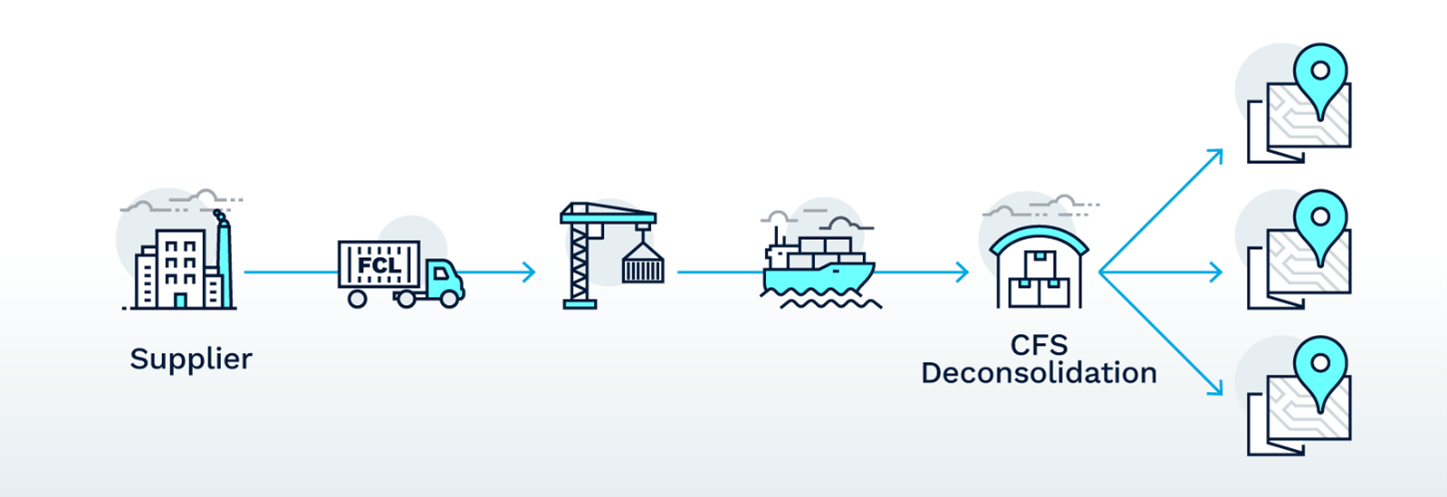
In seller’s consolidation, a large supplier in China, for instance, might be shipping to multiple customers in the US and Canada. These separate shipments are loaded into a container at the factory and sent to the origin port and on to the destination port, where the individual shipments are deconsolidated and sent to different customers.
Best for:
- Large factories exporting to many buyers
- Suppliers wanting control over consolidation
- Businesses needing predictable lead times per customer
Seller’s Consolidation
2. LCL Shipping – Buyer’s Consolidation
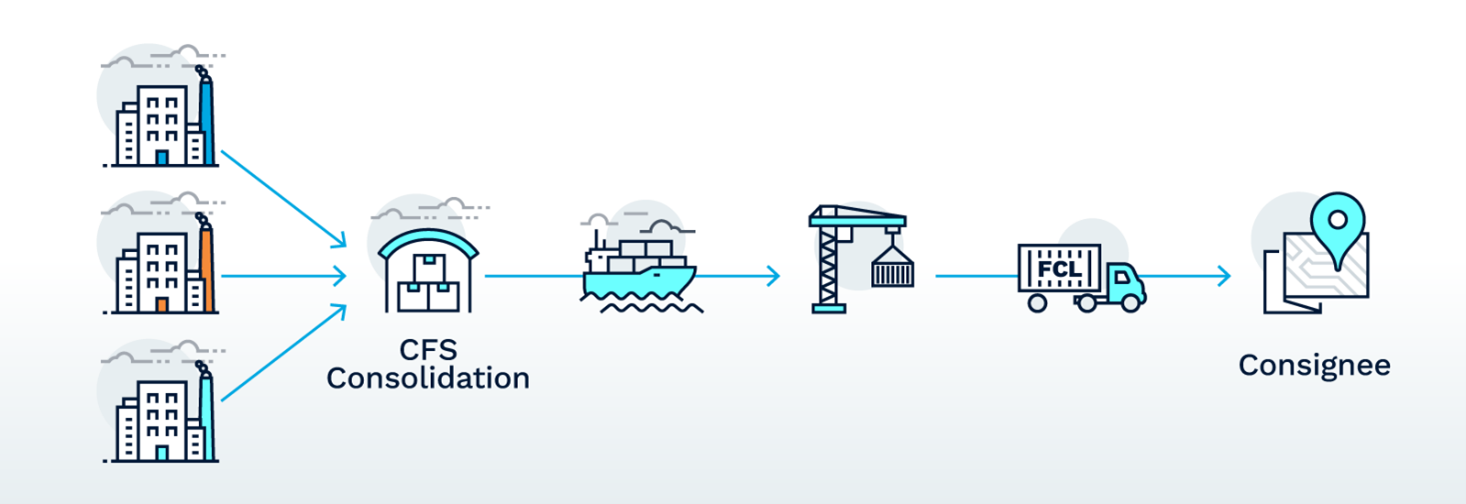
A buyer’s consolidation service combines shipments from multiple suppliers bound for the same overseas customer. If you’re a North American importer, it’s ideal if you’re buying from multiple suppliers in the same region – let’s say the popular manufacturing hub of Shenzhen China. It is typically used under FCA Origin when supplier quantities are small. When suppliers utilize the importer’s designated freight forwarder, the entire process becomes simple and cost-effective.
Reasons importers prefer buyer’s consolidation:
- Pay lower FCL rates by consolidating multiple LCL shipments
- Only one forwarder manages transport, compliance, and delivery
- Simplified coordination and visibility
- Lower damage risk due to fewer handling events
3. LCL Shipping – Consolidation Box (Premium LCL Service)
Large freight forwarders like Dimerco operate high-volume LCL consolidation services. These containers are pre-booked and operate on fixed weekly schedules.
Advantages of consolidation boxes:
- Faster door-to-door transit time — consolidated containers go directly from port to a nearby warehouse for next-day deconsolidation
- Lower total landed costs due to single-invoice pricing from a full-service 3PL
- Higher predictability on sailing and cargo availability
- Reduced risk of delays from co-loaders or sub-contracted partners
What to Look for in an LCL Container Consolidation Partner
If you are in the market for a reliable partner for LCL container shipping services from China to North America, look for the following characteristics:
- Enough volume to sustain regular consolidations. You want reliability in your shipping schedule. Predictable sailing dates for consolidation boxes help.
- Direct offices at origin and destination. Otherwise, you must reach out to multiple partners for answers on freight status and other questions.
- Single-source, end-to-end services – from origin to final destination. That includes land-side trucking, along with CFS, NVOCC, and customs clearance services. This advantage also comes with more transparent pricing.
- Direct routing. You don’t want to wait while your cargo stops at other ports before reaching yours.
- Online visibility to freight status. This avoids phone calls and emails and lets you plan better.
Real-World Use Cases: When LCL Shipping Makes Sense
- Startups and fast-growing ecommerce brands – They often need small but frequent cycles to keep inventory fresh.
- Suppliers shipping immediately after production – Commitments to customers (or VAT incentives) may prevent waiting for a full load.
- Businesses sourcing from multiple small suppliers – LCL or buyer’s consolidation reduces fragmentation and cost.
- Importers needing predictable budget control – LCL consolidation often offers fixed rate agreements.
FAQ: Common Questions About LCL Shipping
When should I choose LCL?
Choose LCL shipping when:
- Your shipment is under 20 CBM
- Cash flow benefits from shipping smaller, more frequent batches
- You cannot hold inventory to build FCL
- Your suppliers are clustered in the same region
- Flexibility is more important than speed
When is FCL better?
Choose FCL when:
- Your ocean freight volume consistently fills a container
- You want the fastest, most predictable transit
- You need reduced handling risk
- Your supply chain requires maximum schedule control
Is LCL slower than FCL?
Generally yes, because of additional handling at origin and destination. Premium LCL consolidation boxes, however, can significantly reduce total transit time.
Dimerco’s Transpacific LCL Consolidation Service
For transpacific container freight, Dimerco’s network of 130+ forwarding offices across Mainland China, Hong Kong, Taiwan, and Southeast Asia drives significant demand for LCL consolidation services among US and Canadian importers and their Asia suppliers. That translates into regular, scheduled shipping of consolidation boxes.
Dimerco offices in Asia collaborate closely with the company’s 20 offices across the US and Canada, particularly our Los Angeles, San Francisco and Vancouver offices.
Some advantages of Dimerco’s LCL container consolidation program:
- Reduced shipping costs
- Ability to offer fixed, long-term rate agreements vs. FCL or air
- Single-source solution from pickup to final delivery
- One point of contact supported by a global operating system
- Dedicated carrier contracts and pre-booked space
- Direct service to destination ports
- CFS services in key US and Canadian cities
- Up to 32% lower CFS costs in Dimerco-operated facilities (e.g., San Francisco)
- Regular weekly consolidations from Asia to North America
- Check out the current schedule below (contact Dimerco for updates).
Dimerco LCL Consolidation Schedule from Mainland China and Taiwan to North America
| Origin | Destination | Frequency | Cut Off | ETD | Transit Time |
|---|---|---|---|---|---|
| Shenzhen | Toronto | Weekly | Wed | Next Tues | 23 days |
| Shenzhen | Montreal | Weekly | Wed | Next Tues | 23 days |
| Shenzhen | Vancouver | Weekly | Wed | Next Tues | 13 days |
| Shanghai | Toronto | Weekly | Sun | Wed | 24 days |
| Shanghai | Montreal | Weekly | Sun | Wed | 24 days |
| Shanghai | Vancouver | Weekly | Wed | Sun | 16 days |
| Shanghai | Los Angeles / Long Beach | Weekly | Thur | Next Tues | 15–16 days |
| Ningbo | Toronto | Weekly | Wed | Next Mon | 32 days |
| Ningbo | Montreal | Weekly | Wed | Next Mon | 32 days |
| Ningbo | Vancouver | Weekly | Wed | Sun | 18 days |
| Ningbo | Los Angeles / Long Beach | Bi-weekly | Wed | Next Mon | 15–16 days |
| Ningbo | Chicago | Weekly | Fri | Next Wed | 28 days |
| Taiwan | Vancouver | Weekly | Mon | Next Wed | 12 days |
| Taiwan | Toronto | Weekly | Mon | Next Wed | 22 days |
| Taiwan | Los Angeles / Long Beach | Bi-weekly | Wed | Next Tues/Fri | 15 days |
Need LCL Container Shipping from Asia to US and Canada?
For small and mid-sized shippers that don’t have the volume to fill a container, LCL container shipping can yield significant savings over the course of a year. Are you looking for LCL container consolidation services? Dimerco has several direct, Asia-to-North America routes that put you on the path to lowering your ocean freight costs. To learn how LCL container consolidation can benefit your business, contact Dimerco today.