The fashion industry, built for speed, often relies on supply chains that are anything but agile. These rigid, slow-moving systems are often ill-suited to serve a business sector that reinvents itself every season.
In this post, we’ll spotlight the biggest challenges facing the fashion supply chain today and explore how brands can position themselves to thrive in an unpredictable environment. We’ll focus on the strategic importance of Asia-to-Europe and Asia-to-US trade lanes, plus real examples of how Dimerco has helped customers shine.
Why the Supply Chain Feels Like a Never-Ending Fashion Emergency
When fashion companies gear up to fill shelves for a promotional launch or retail blitz, they must balance competing priorities for speed, cost, resilience, and sustainability. To move short-shelf-life products on time, brands are building more diversified sourcing networks across Asia while maintaining flexible transportation strategies that allow them to react quickly to changing consumer demand.
Demand Forecasting & Inventory Risk
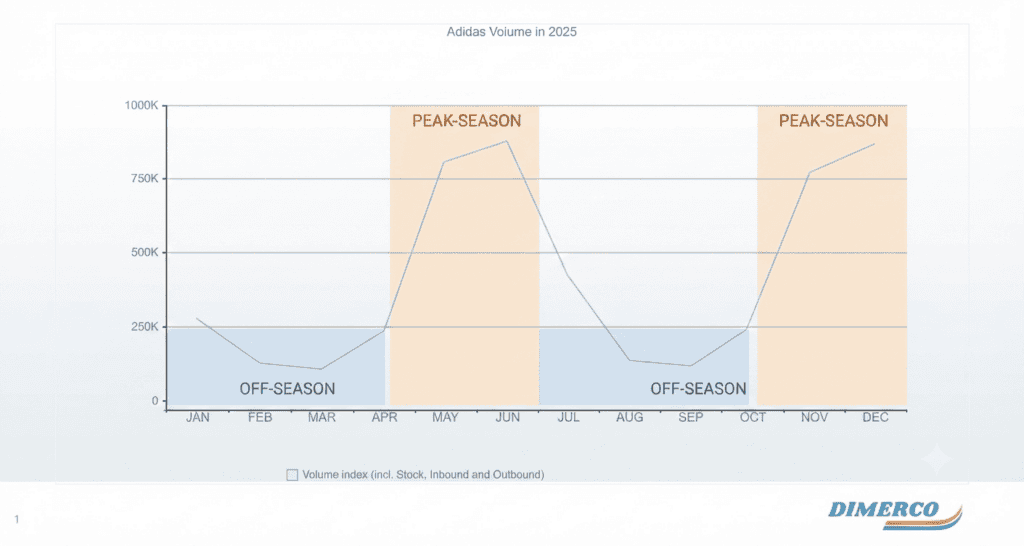
Managing fashion logistics is effectively managing a rollercoaster of throughput. Fashion trends change quickly, making demand difficult to predict. Overstock leads to markdowns, while understock results in lost sales. However, overproduction is often a strategic choice for fast-fashion retailers, who report up to 5 billion items of excess stock.
Without a professional and experienced 3PL partner, fashion brands face significant financial risks:
Labor workforce elasticity. During peak seasons, a warehouse requires 3 to 5 times the warehouse staff to meet tight delivery windows. Conversely, maintaining a large permanent warehouse staff during off-seasons leads to extreme inefficiency and wasted labor costs.
Warehouse space optimization. Customers cannot afford to be out of stock during peak seasons, yet leasing permanent warehouse space to accommodate the peak inventory is prohibitively expensive. Keeping excess warehouse space empty during quiet months is a massive drain on operational budgets.
Your network must be prepared to handle extreme volume fluctuations, ensuring warehouse throughput can scale up instantly during peak season.
Asia Transit Times
Products sourced from Asia can take weeks to reach the market via ocean. Dimerco’s network typically moves freight in 15–22 days to major South/East China ports and the US West Coast, and 30–40+ days to East/Gulf Coast destinations. Air freight from Asia to U.S. destinations usually arrives in 1-5 days for airport-to-airport service.
Disruptions from port congestion, blank sailings, equipment shortages, weather events, and labor issues can delay transit times and impact seasonal sales.
To balance speed and costs, many brands use a combination of ocean and air to maintain inventory availability through tailored logistics solutions.
Geopolitical & Trade Uncertainty
Tariffs, trade disputes, and regulatory changes can increase costs and disrupt sourcing strategies. De-risking through diversified sourcing and contingency plans can help alleviate disruptions.
New regulations, such as the EU Corporate Sustainability Due Diligence Directive, are forcing fashion brands to gain visibility beyond first-tier suppliers, transforming traceability and supplier documentation into strategic business requirements rather than optional sustainability initiatives.
Multi-Country Sourcing Complexity
Fashion products often involve materials, manufacturing, and distribution across multiple countries, creating coordination and visibility challenges. To ensure supply, 51% of fashion brands are building long-term strategic partnerships with suppliers, including volume commitments, according to McKinsey research.
Why Origin Analysis and UFLPA Risk Assessments Are Essential for Fashion Importers
For fashion brands importing into the United States, determining the correct country of origin is no longer just a customs formality—it is a critical component of trade compliance and supply chain risk management.
Apparel and footwear often involve complex manufacturing processes spanning multiple countries, making origin determinations increasingly challenging. Importers must be able to document where substantial transformation occurred, the origin of component materials, and maintain supporting production records that demonstrate compliance with U.S. Customs requirements.
Accurate country-of-origin analysis not only ensures proper duty assessment, compliance with evolving trade regulations, and labeling but also facilitates a brand’s use of preferential trade programs to its advantage.
At the same time, the Uyghur Forced Labor Prevention Act (UFLPA) has fundamentally changed the expectations placed on fashion companies. U.S. Customs and Border Protection (CBP) now expects importers to conduct meaningful supply chain due diligence, including supplier mapping, traceability, and comprehensive risk assessments that extend beyond direct suppliers to raw material sources.
Brands must be able to identify the origins of fibers, yarns, fabrics, and finished garments while maintaining documentation for every step of the supply chain. And recent advisories on compliance and CTPAT membership further reinforce the government’s efforts to embed UFLPA compliance across all its trade-facing programs.
Companies that invest in origin analysis, supplier mapping, traceability programs, and ongoing compliance reviews are better positioned to prevent costly shipment detentions, avoid enforcement actions, protect their brand reputation, and demonstrate the reasonable care expected by U.S. Customs in today’s increasingly complex global sourcing environment.
Transforming the Global Fashion Supply Chain
The most successful fashion shippers take a proactive approach to risk management. They partner with logistics providers that guide them through customs compliance in new source countries and offer flexibility in modes, routing, and warehousing.
Supply chain diversification: Many companies are expanding sourcing beyond China into Vietnam, India, Bangladesh, Indonesia, and other Southeast Asian markets to reduce risk. Overall, Asian countries accounted for 71.5% of the total value of U.S. apparel imports. U.S. apparel imports from Vietnam alone grew 17.5% in 2025 compared to the prior year. The EU, the world’s largest importer of apparel, also has the highest market share of imports from developing countries.
Trade policy and tariff changes: Ongoing geopolitical developments and changing trade regulations continue to impact sourcing decisions and landed costs. More than 3,000 trade restrictions were imposed in 2023, impeding the flow of goods around the world.
Technology and visibility: Real-time shipment tracking, predictive analytics, and supply chain visibility tools are becoming essential rather than nice-to-haves. With the lifespan of ultra-fast fashion measured in days, retailers can’t afford to lose sight of their inventory.
Multimodal solutions: Dimerco advises on selecting the best mode for each situation: ocean freight for planned inventory replenishment, air freight for urgent shipments, and linking road and rail options when flexibility is required. We also help customers diversify carriers, optimize routing, and develop contingency plans to mitigate disruptions.
Fashion Warehousing in China and Southeast Asia
For fashion brands, warehousing services in China and Southeast Asia must extend beyond simple storage. Strategic warehouse locations provide inventory visibility, supplier consolidation, quality control, and value-added services that help brands reduce costs while maintaining the flexibility needed to respond to fast-changing consumer tastes.
As production shifts away from China, warehouses across Southeast Asia support multi-country sourcing and distribution. Use warehouses that can consolidate shipments from multiple sources into a single export load, reducing transportation costs and improving efficiency at the receiving end.
With product moving via a central location, warehouses can quickly handle changing demand, seasonal peaks, and last-minute order adjustments.
Dimerco warehouses offer value-added services, such as labeling, ticketing, repacking, quality inspections, and retail compliance preparation, to ensure products are retail-ready upon arrival.
Dimerco’s Customs Expertise for Fashion
The last thing a fashion shipper needs is a load of the trendiest threads halted at the border due to a customs violation.
With deep, on-the-ground experience across Southeast Asia, Dimerco helps customers navigate complex import and export regulations, ensure accurate documentation, and stay compliant with changing trade requirements.
We know that in the current environment, customs compliance must focus on managing risk as well as clearing cargo. Our expertise helps customers avoid delays, reduce compliance exposure, and keep products moving efficiently across borders to keep the shelves full.
Custom Fashion Supply Chain Solutions
Don’t cut corners on your fashion supply chain strategy. Fashion brands are finding that relying on lean, cost-driven supply chains will leave them stranded when shipments are rolled or get caught up in customs. The supply chain has to be agile enough to overcome problems and manage risks to ensure product availability and meet changing consumer demand.
Dimerco’s team works closely with fashion customers to understand their business priorities, inventory requirements, and service expectations. We don’t use a one-size-fits-all approach. Our transportation solutions balance cost, transit time, and supply chain resilience.
For Adidas, Dimerco provides comprehensive value-added services (VAS) to ensure every product from the customer’s manufacturer and suppliers is retail-ready and brand-perfect before it reaches the customer’s hands:
Quality Control. Conduct detailed inspections to ensure products meet brand standards.
Retail Packaging. Repackage product to suit specific market requirements, such as restoring damaged shoeboxes/plastic bags, replacing or affixing localized care labels/SKU stickers/regional price tags, and upgrading external shipping packaging to align with premium brand guidelines, ensuring full regulatory and market-specific compliance.
Performing these services in Dimerco’s Hong Kong warehouse reduces the time-to-market and eliminates the need for expensive, redundant handling at the destination, ultimately allowing Adidas to maintain brand consistency while significantly shortening its supply chain cycles.
Customer Success: Fashion Supply Chains
By combining our Asia network, transportation expertise, and local market knowledge, Dimerco helps customers navigate disruptions, maintain inventory flow, and respond quickly to changing market demands.
Apparel Customer
Apparel brand Concepts in Time was handling scattered incoming orders from multiple Chinese manufacturers for shipment to a U.S. retailer. Dimerco directed goods to the customs-bonded warehouse in Yantian for unified sorting, retailer labeling, and container loading. Products are customs-declared for export and trucked to an LCL consolidation center.
Consolidating small batches from different factories into full containers allows access to lower FCL rates and avoids expensive LCL surcharges. Labeling and repacking in domestic bonded warehouses cost far less than equivalent overseas warehouse services.
Goods are deemed exported on entry into the Dimerco warehouse, enabling early export tax rebate processing. All operations are under customs supervision with full compliance records.
With advanced tax rebate applications, the capital turnover cycle is shortened by 20–30 days compared with traditional tax rebate procedures after vessel departure. It eases suppliers’ cash pressure and indirectly reduces buyers’ overall procurement costs.
The process lowers overall logistics costs and optimizes capital flow through early tax rebates.
Fashion Retail Customer
When a U.S.-based apparel company needed reliable replenishment shipments from Asia to support its e-commerce operations, Dimerco developed a scheduled airfreight solution from Vietnam to the U.S.
By providing consistent capacity, shipment visibility, and proactive coordination between origin and destination teams, we helped the customer maintain inventory availability and meet delivery expectations despite ongoing market volatility.
Global Fashion Sourcing Customer
For a global fashion sourcing and brand management company with production across multiple Asian countries, Dimerco leveraged its extensive network in Asia to coordinate shipments from various manufacturing locations and provide customs and transportation expertise.
This network enabled the customer to improve supply chain visibility, maintain flexibility during disruptions, and ensure products reached key markets on time.
With more than 150 offices across Asia, Dimerco is well positioned to connect regional logistics and manufacturing hubs to customers in Europe and North America.
As the region’s warehouse landscape continues to evolve, the combination of local expertise, integrated services, and technology-enabled operations supports high-volume, high-velocity supply chains in the world of fashion.
If you’re evaluating your Asia fashion supply chain strategy — looking at cost, service levels, supply chain flexibility, or cross-border fulfillment compliance — contact Dimerco’s logistics specialists to discuss what the right solution looks like for you.