
This practical guide helps importers, exporters, and manufacturers compare bonded warehouses and Foreign Trade Zone (FTZ) warehouses – especially for companies operating in Asia-Pacific supply chains. You will learn:
- Key definitions and differences
- Region-specific considerations
- How to evaluate the right solution for your business
- Step-by-step guidance on how to ship from an FTZ
- When each model reduces cost, improves speed, or strengthens compliance
What Is the Difference Between a Bonded Warehouse and an FTZ Warehouse?
Both bonded warehouses and FTZ warehouses provide secure storage for imported goods while offering duty deferment benefits. However, their operations and advantages vary:
| Feature | FTZ Warehouse | Bonded Warehouse |
|---|---|---|
| Duty Deferral | Duties and taxes are deferred until goods enter the domestic market. | Duties are deferred until goods leave the warehouse for domestic distribution. |
| Manufacturing & Manipulation | Allows repacking, relabeling, light assembly, and sometimes full manufacturing. | Limited to basic storage and repacking. |
| Export Benefits | Ideal for goods that will be re-exported, potentially avoiding duties altogether. | Allows duty drawback if goods are re-exported. |
| Domestic Distribution | Requires customs clearance before goods enter the local market. | More suitable for domestic distribution as goods are already within the customs territory. |
| Setup Costs & Complexity | Higher setup costs and regulatory requirements. | Easier and less expensive to set up. |
| Storage Duration | Varies by country; often unlimited in the US | Typically has a time limit (e.g., five years in the US and EU, shorter in some Asian countries). |
What Is a Foreign Trade Zone (FTZ) Warehouse?
A Foreign Trade Zone (FTZ) warehouse, sometimes referred to as a free trade zone warehouse, operates outside a country’s normal customs territory. This means businesses can store, process, and even manufacture goods without immediately incurring duties or taxes.
Key Benefits of an FTZ Warehouse
- Duty Deferral & Reduction: Duties are only paid when goods leave the FTZ for domestic distribution. In some cases, businesses can reduce costs by paying duties on the finished product rather than raw materials.
- Tax Advantages: Some FTZ locations offer exemptions or reductions on state and local taxes.
- Inverted Duty Strategy: Companies may qualify for lower duty rates based on whether they import raw materials or finished products.
- Merchandise Processing Fee (MPF) Savings: In the US, weekly imports can be consolidated into one entry, significantly reducing MPF costs.
Considerations Before Using an FTZ Warehouse
- Higher Setup Costs: Establishing an FTZ can be more expensive than using a bonded warehouse.
- Regulatory Oversight: Customs authorities monitor FTZ activities to ensure compliance.
- Focus on Exporting: FTZ warehouses are ideal for companies focused on international trade rather than domestic distribution.
What Is a Bonded Warehouse?
A bonded warehouse is a secure storage facility where imported goods can be held without paying duties until they are sold or re-exported. This allows businesses to defer duty payments and, in some cases, claim a duty drawback when goods are re-exported.
Key Benefits of a Bonded Warehouse
- Duty Deferral: Pay duties only when goods leave the warehouse for local sale.
- Duty Drawback: If goods are re-exported, previously paid duties can be refunded.
- Simpler Setup: Bonded warehouses have fewer regulatory requirements than FTZs, making them easier and cheaper to establish.
Considerations Before Using a Bonded Warehouse
- Limited Activities: Only basic storage and repacking are allowed – no manufacturing or significant modifications.
- Fixed Duty Rates: Duties are calculated based on the condition of goods at the time of entry, unlike FTZs, which allow for inverted duty strategies.
- Storage Limits: Many countries impose time restrictions on bonded storage (e.g., five years in the US and EU, varying limits in Asia).
How to Choose Between an FTZ Warehouse and a Bonded Warehouse
To determine whether an FTZ warehouse or a bonded warehouse is right for your business, consider these key questions:
1. What Are Your Goods?
- High-duty items: FTZs can help reduce overall duty costs.
- Goods for re-export: A bonded warehouse allows for duty drawback on re-exported products.
2. What Operations Do You Need?
- Need to manipulate or manufacture goods? FTZs allow value-added activities.
- Just need storage? A bonded warehouse is a simpler, cost-effective option.
3. How Long Do You Need to Store Inventory?
- Long-term storage? FTZ warehouses typically offer unlimited storage in some regions.
- Short-term storage? Bonded warehouses may have restrictions (e.g., five-year limits in the US and EU).
4. Where Are Your Customers?
- Export-focused? FTZs are ideal for businesses shipping internationally.
- Selling domestically? Bonded warehouses allow for a smoother transition into the local market.
5. How Much Control Do You Need Over Inventory?
- Greater flexibility? FTZs allow manipulation and repackaging.
- Simpler compliance? Bonded warehouses have fewer regulatory requirements.
6. What Is Your Import Volume?
- High volume & frequent re-export? FTZs can be more cost-effective.
- Lower volume & local distribution? Bonded warehouses offer a faster, less expensive setup.
7. Are You Comfortable Managing Regulations?
- Okay with complex regulations? FTZs require more compliance oversight.
- Prefer straightforward operations? Bonded warehouses are easier to manage.
How to Ship From an FTZ: A Practical Workflow
Step-by-Step Guide
1. Receive Goods Into the FTZ -Goods enter the zone under FTZ status without duties or taxes.
2. Conduct Value-Added Operations (Optional) – Repacking, kitting, light assembly, or manufacturing as allowed by local FTZ rules.
3. Prepare for Domestic Shipment – Submit customs entry documentation to local customs authorities.
4. Pay Duties (If Required) – Duties assessed based on finished-goods classification, potentially reducing costs.
5. Release Goods Into the Domestic Market – Goods leave FTZ status and enter normal commerce.
6. For Exports: Goods may exit duty-free, depending on the country’s FTZ rules.
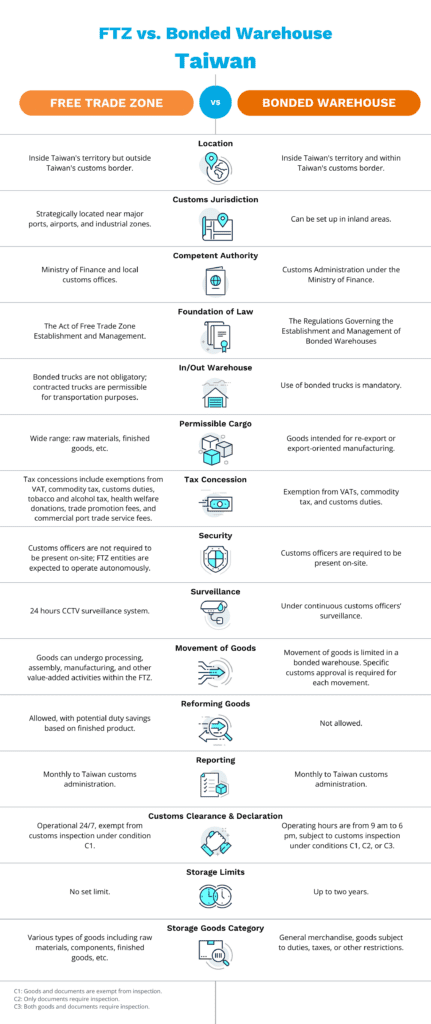
Region Spotlight: FTZ vs. Bonded Warehouse Regulations in the US and Taiwan
Asia-Pacific supply chains often rely on free trade zone logistics in Asia, which differ significantly by market. The US and Taiwan both offer FTZ and bonded warehouse options, but their regulations, storage limits, and cost structures differ significantly. Understanding these differences can help you determine which solution best aligns with your supply chain strategy, whether you’re importing goods for domestic distribution or re-exporting to global markets. Let’s break down how US vs. Taiwan FTZ and bonded warehouse regulations compare.

Partnering With Experts to Optimize Your FTZ or Bonded Warehouse Strategy
Deciding between an FTZ warehouse and a bonded warehouse requires a strategic approach. Partnering with an experienced logistics provider can help you navigate the regulations, minimize costs, and optimize your supply chain.
A logistics partner like Dimerco helps you:
- Navigate customs regulations
- Reduce landed cost through duty and tax strategies
- Integrate air, ocean, and contract logistics with zone operations
- Build Asia-focused free trade zone logistics strategies
Dimerco’s FTZ and bonded warehouse footprint includes:
Ready to optimize your storage and distribution strategy? Contact Dimerco today to discuss how an FTZ warehouse or bonded warehouse can benefit your business.
For further reading, explore our eBook Strategic Warehousing in Asia-Pac, which provides deeper guidance on cost optimization and trade-zone evaluation. eBook
